The short answer
Groundworks are expensive because they combine heavy excavation, large volumes of concrete and aggregate, costly spoil disposal, plant hire and skilled labour — all on the most unpredictable part of any build. Removing excavated soil (muck away) is charged by the lorry load and rises sharply on deep digs; concrete and aggregate are priced by volume; and ground that turns out softer, wetter or more contaminated than expected forces deeper or engineered foundations on the spot. The work is also safety-critical and inspected against Building Regulations Part A, so corners cannot be cut. The result is a high cost for something that ends up buried and invisible.
Homeowners and self-builders are often shocked that work they will never see costs so much. The expense is real and has clear causes rather than padding. The sections below break down where the money genuinely goes and why the figure is so hard to fix in advance.
At a glance
- Biggest hidden costSpoil disposal (muck away)
- Priced by volumeConcrete, aggregate, dig
- Main riskUnknown ground conditions
- Safety standardPart A, inspected
- Why it feels dearIt ends up invisible
Where the money actually goes
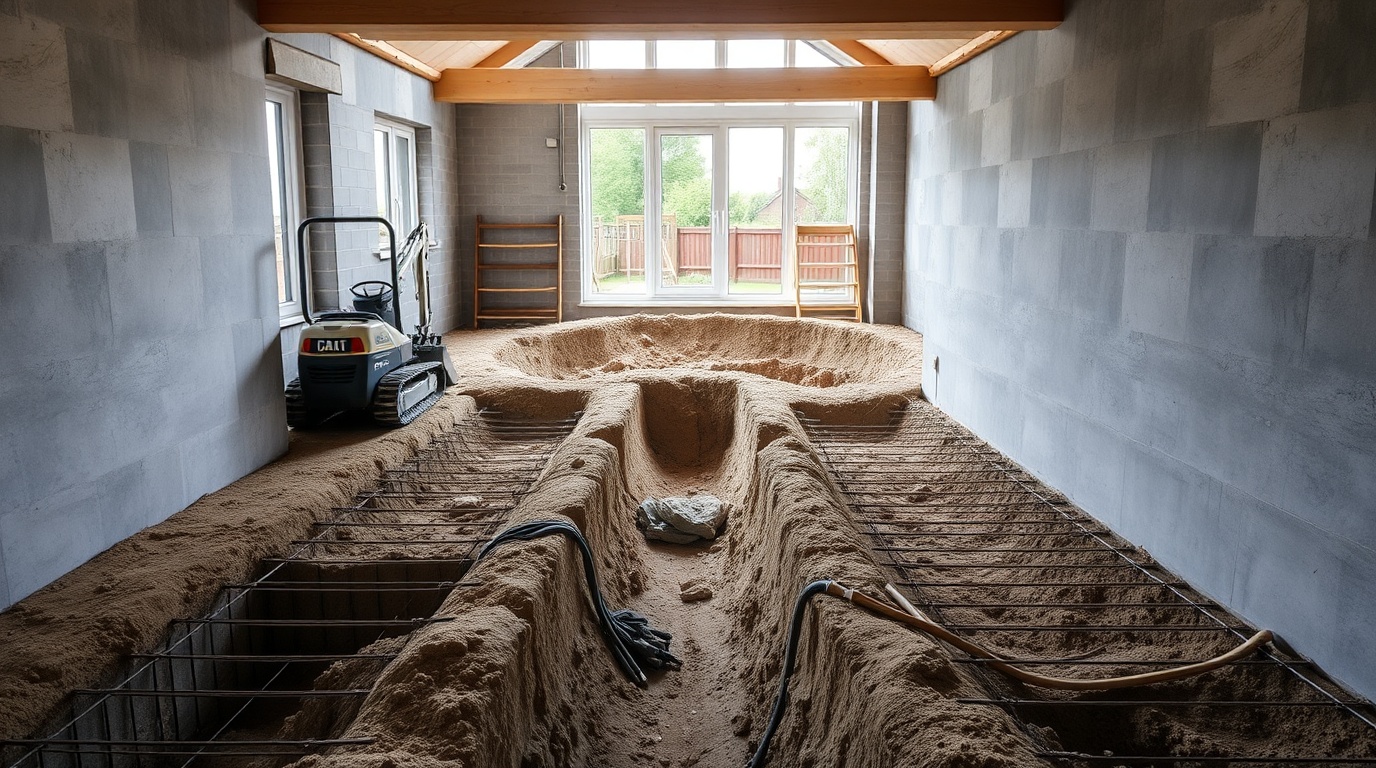
The cost of groundworks is spread across several heavy, unavoidable items rather than one. Excavation needs plant and operators; the soil that comes out has to be carted away and tipped, which is charged by weight or load and is one of the largest single costs; the foundations swallow large volumes of concrete and reinforcement; and the floor needs aggregate, insulation and either a slab or beam-and-block. Each of these is a genuine material or disposal cost that scales with the size and depth of the job.
| Cost element | Why it is expensive | Scales with |
|---|---|---|
| Spoil disposal (muck away) | Tipping fees + haulage per load | Dig depth and volume |
| Concrete | Priced per cubic metre delivered | Foundation depth/width |
| Sub-base / aggregate | Bulk material + compaction | Floor area |
| Plant hire | Diggers, dumpers, operators | Site size, duration |
| Skilled labour | Carded, safety-critical work | Complexity |
Indicative breakdown of where groundworks money goes. Proportions vary by project.
Spoil disposal — the cost people forget
One of the biggest surprises is how much it costs to get rid of the soil that comes out of the ground. Muck away is charged by the lorry load and includes both the haulage and the tipping fee at a licensed site, and that fee rises if the spoil is classed as contaminated. On a deep foundation or a large reduced-level dig, the volume removed is enormous — far more than the trench looks from the surface — and each load is a fixed cost regardless of how cheap the digging itself was.
This is why a deeper-than-expected foundation hurts twice: more concrete goes in, and more spoil comes out, both charged by volume. On a sloping plot that needs cut-and-fill, or a site with old foundations, hardcore or contaminated ground, disposal can become one of the single largest lines in the whole quote. There is little a groundworker can do to reduce it — the soil has to go somewhere legal — which is part of why the figure is high and largely fixed by the ground rather than negotiable.
The ground is the real reason it varies
Groundworks are expensive partly because they are uncertain. The foundation design depends on the soil, which cannot be fully known until the digger is in the trench. Shrinkable clay, especially near trees, demands deeper foundations under NHBC and Building Control rules; made-up ground, peat or a high water table can rule out a normal footing and force piling or a raft, multiplying the cost. Building Control inspects the open trench before any concrete is poured and can require a deeper or reinforced foundation there and then.
This is why two identical houses can have very different groundworks bills, and why honest groundworkers price in some caution or a provisional sum for depth. It is also why a soil survey at the design stage is worth the money — it lets the structural engineer specify the right foundation, so the quote reflects reality rather than an optimistic guess that gets corrected, expensively, on site. The unpredictability is not the groundworker inflating the price; it is the ground genuinely costing more to build on than it appears from the surface.
With most parts of a build, if the budget is tight you can choose a cheaper option — a different worktop, simpler joinery, a less expensive roof tile. Groundworks do not work that way, and this is part of why they feel so unyielding on cost. The foundation depth and type are set by the ground and the building loads, calculated by a structural engineer and confirmed by Building Control, not chosen for budget. You cannot fit a shallower foundation to save money the way you can fit a cheaper kitchen, because a foundation that is not deep or strong enough will fail, and the building above it with it.
The same applies to the drainage, the sub-base and the floor — each is sized for a job, and undersizing them stores up expensive failure. This is why the honest savings in groundworks come not from cutting the specification but from reducing the work the ground forces on you: getting a soil survey so the foundation is designed once and correctly, reusing clean spoil on site to cut disposal, balancing cut-and-fill on a slope, and ensuring good plant access so concrete is placed efficiently. These reduce cost without compromising the result. What does not work is shopping purely on the lowest quote, because the lowest price often reflects a thinner specification or excluded items that reappear later as failures or extras. The expense of groundworks is largely fixed by physics and regulation, and the skill is in not paying for more than the ground genuinely requires rather than in trimming below what it needs.
Plant, labour and the cost of doing it safely
Beyond materials and disposal, groundworks carry the cost of heavy plant and skilled, safety-critical labour. Diggers, dumpers, rollers and concrete pumps are hired by the day or week with operators, and an excavation deep enough to stand in must be supported or battered back to prevent collapse under CDM and trench safety rules — a genuine, non-negotiable cost. The work is also unforgiving: a foundation set wrong or a drainage fall laid backwards is buried in concrete and ruinously expensive to correct, so it has to be right first time, which demands experienced crews rather than cheap labour.
The work is inspected too. Building Control checks the open foundation, the drainage before backfill and the oversite, and on a new home the warranty provider adds its own standards. All of this means groundworks cannot be value-engineered the way a visible finish can — you cannot use a cheaper foundation the way you might choose a cheaper worktop. The expense reflects volume materials, unavoidable disposal, heavy plant, skilled labour and below-ground risk on the one part of a build that absolutely must not fail. The most effective way to keep it under control is not to shop on price alone but to get the ground surveyed and the foundation properly designed, so the quote is realistic and the surprises are minimised.
Frequently asked questions
What is the most expensive part of groundworks?
Usually spoil disposal (muck away) and concrete, both charged by volume, plus plant hire and labour. On a deep or difficult dig, getting rid of the excavated soil can be one of the single largest lines in the quote.
Can I reduce my groundworks cost?
A soil survey and a proper foundation design avoid the costly surprise of digging deeper than assumed. Good access for plant, minimising spoil, and a fixed-price quote against a real design all help — but the core cost is set by the ground and cannot be cut safely.
Why are groundworks more than I expected?
Because the cost is driven by below-ground conditions you cannot see. Deeper foundations, soft or contaminated ground, more spoil to remove and unrecorded drains all push the figure up, and these only become clear once digging starts.
Sources & further reading
- Checkatrade — groundworks cost guide
- HSE — excavations and trench safety
- Planning Portal — Building Regulations
Figures on this page are typical UK ranges drawn from published sources and depend on your specific site. They are guidance, not a quotation.