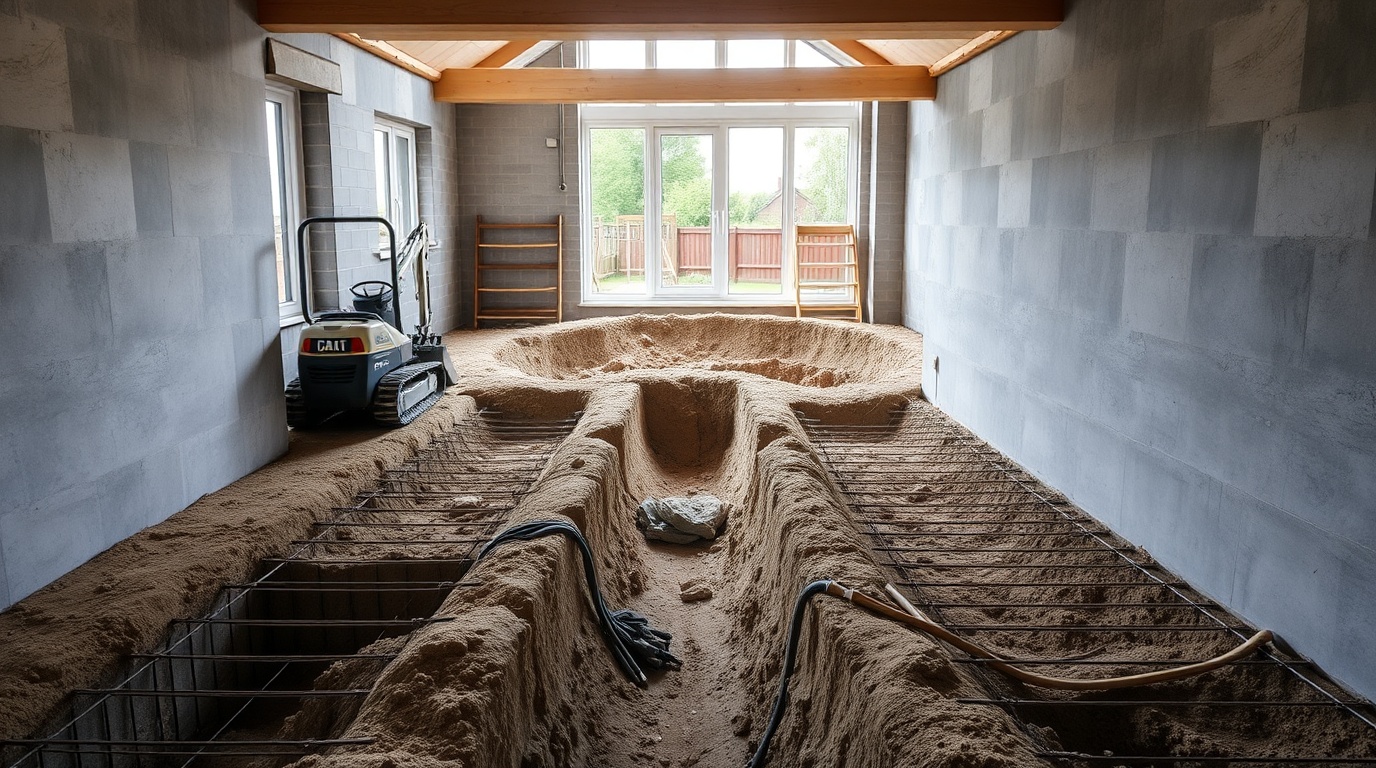
The short answer
For most UK house extensions on reasonable ground, the foundation is a trench fill or traditional strip footing dug down to firm, undisturbed soil. The type you actually need is decided by the ground conditions, soil type and load, not by preference: clay subject to seasonal shrinkage, nearby trees, made-up ground, a high water table or sloping sites all push you towards deeper trench fill, a reinforced raft, or piled foundations with ground beams. The legal benchmark is Part A (structure) of the Building Regulations, and the depth and design are confirmed on site by your Building Control surveyor inspecting the open trench before any concrete is poured. On problem ground a structural engineer designs the solution, so the honest answer is that the soil decides.
There is no single "extension foundation". The right type comes from what is under your garden, what is growing near it and what you are building on top. Below is how each option is chosen and signed off in England and Wales.
Foundation types at a glance
- Most commonTrench fill or strip footing
- Minimum depth (general)Usually at least 0.75–1.0m
- Clay near treesOften 1.5–3.0m+
- Poor / made groundRaft or piled design
- Sign-offBuilding Control inspects open trench
The four foundations you are choosing between
- Traditional strip: a band of concrete (often around 150–300mm thick) at the base of a trench, with masonry built off it. Suited to firm ground at modest depth.
- Trench fill: the trench is filled almost to the surface with concrete instead of building masonry up from a thin strip. It uses more concrete but far less bricklaying below ground, so it is now the default on many domestic extensions, especially where trenches are deep.
- Raft: a single reinforced concrete slab spreading the load over the whole footprint. Used on weaker or variable ground, made-up ground, or where deep trenches would be impractical.
- Piled with ground beams: concrete or screw piles taken down to a firm stratum, tied together by reinforced ground beams. Used where shrinkable clay, trees, deep fill or a high water table make conventional trenches uneconomic or risky.
What actually decides which one you need
The decision is driven by the ground, not the build. A trial hole or soil assessment shows the bearing stratum and water table; the presence of shrinkable clay and nearby trees dictates depth under NHBC guidance; and sulfates or made-up ground can force a particular concrete mix or a raft. Building Control (or an Approved Inspector) checks the open trench against Part A before the pour. Where conditions are difficult, a structural engineer's design becomes the governing document.
| Ground condition | Typical foundation | Why |
|---|---|---|
| Firm gravel / sand, no trees | Strip or shallow trench fill | Good bearing near the surface |
| Shrinkable clay near trees | Deep trench fill or piles | Soil moves with seasons and roots |
| Made-up / variable ground | Reinforced raft | Spreads load over soft spots |
| Deep fill, high water table | Piled + ground beams | Reaches firm stratum below |
Indicative guidance only. The design is confirmed by Building Control and, on difficult ground, a structural engineer. Sources: NHBC Standards Chapter 4.2; Planning Portal Part A.
Who signs it off and why depth is checked on site
Your foundation forms part of a Building Regulations application. Most extensions are notified to Building Control as a full plans or building notice submission, and the surveyor will want to inspect the excavation before concrete goes in. They are checking that the trench reaches firm, undisturbed ground at adequate depth and width, free of soft spots, tree roots and standing water. Because nobody can be certain of the ground until it is open, the design depth on a drawing is provisional — the surveyor can require you to dig deeper if the bearing is not what was assumed.
Cost, ground investigation and how to plan
Foundation cost is one of the least predictable parts of an extension precisely because it depends on the ground. A straightforward strip or trench fill on firm soil is a modest share of the groundworks budget, but switching to a deep trench fill near trees, a reinforced raft, or piled foundations with ground beams can add several thousand pounds — sometimes a five-figure sum on difficult sites. The way to control that risk is to investigate the ground before you finalise the design and budget, rather than discovering the problem in an open trench halfway through the build.
- Trial holes: a digger excavates one or more holes to expose the soil profile, water table and any made-up ground, so the bearing stratum and likely depth are known in advance.
- Soil / borehole investigation: on clay or near trees, samples establish the clay's shrinkability (its plasticity), which feeds the NHBC depth tables.
- Drainage check: locating existing drains and any public sewer early avoids a clash between the foundation and a pipe that would otherwise force a redesign.
A little spent on investigation usually saves far more in avoided delay and rework. Where any doubt exists, involve a structural engineer at design stage so the foundation is specified correctly from the outset and Building Control can approve it without surprises on site.
Matching the existing house and the role of the engineer
An extension foundation rarely exists in isolation — it has to relate to the existing house it joins, and that connection often shapes the design as much as the ground does.
- Matching depth at the junction: where the new foundation meets the existing wall, the two generally need to sit at compatible depths. If the old footing is shallow and the new one must go deeper (on clay, say), a short length of underpinning to the existing wall may be specified so there is no abrupt step in support.
- Not assuming the neighbour's solution: soil, tree proximity and load can differ across a few metres, and standards have changed over the decades, so a neighbour's or the original house's foundation is a clue, not a specification.
- Services and drains: existing drains, a public sewer, or buried services near the junction can force the foundation to be designed around them, sometimes bridging a drain under a build-over agreement.
This is where a structural engineer earns their fee. On straightforward, firm, tree-free ground a builder and the Building Control surveyor can agree a standard trench fill without one. But on shrinkable clay near trees, made-up or sloping ground, anything piled or rafted, or where the extension must tie into shallow existing footings, an engineer designs the foundation from the ground investigation and details the junction with the house. Their drawings and calculations become the governing document in your Building Regulations application, and Building Control confirms the design against Part A at the open-trench inspection. The consistent theme across every extension is the same: the ground and the existing building decide the foundation, the design is provisional until the trench is open, and no concrete should be poured until the surveyor has inspected and accepted what the dig reveals.
Frequently asked questions
Can I just match my neighbour's foundations?
Not reliably. Soil, tree proximity and load can differ across a few metres, and standards have changed over the decades. The depth and type are set by your own ground conditions and confirmed by Building Control inspecting your trench.
Do I need a structural engineer for extension foundations?
Not always. On straightforward ground, the builder and Building Control surveyor can agree a standard trench fill. On clay near trees, made-up ground, sloping sites or anything piled, a structural engineer's design is normally required.
Is trench fill better than a traditional strip?
Neither is universally better. Trench fill saves below-ground bricklaying and suits deep trenches, but uses more concrete. Strip suits shallower, firm ground. The depth needed for your site usually decides which is more economic.
Sources & further reading
- Planning Portal — Building Regulations Approved Document A (structure)
- NHBC — Standards Chapter 4 (foundations)
- LABC — building an extension
Figures on this page are typical UK ranges drawn from published sources and depend on your specific site. They are guidance, not a quotation.