The short answer
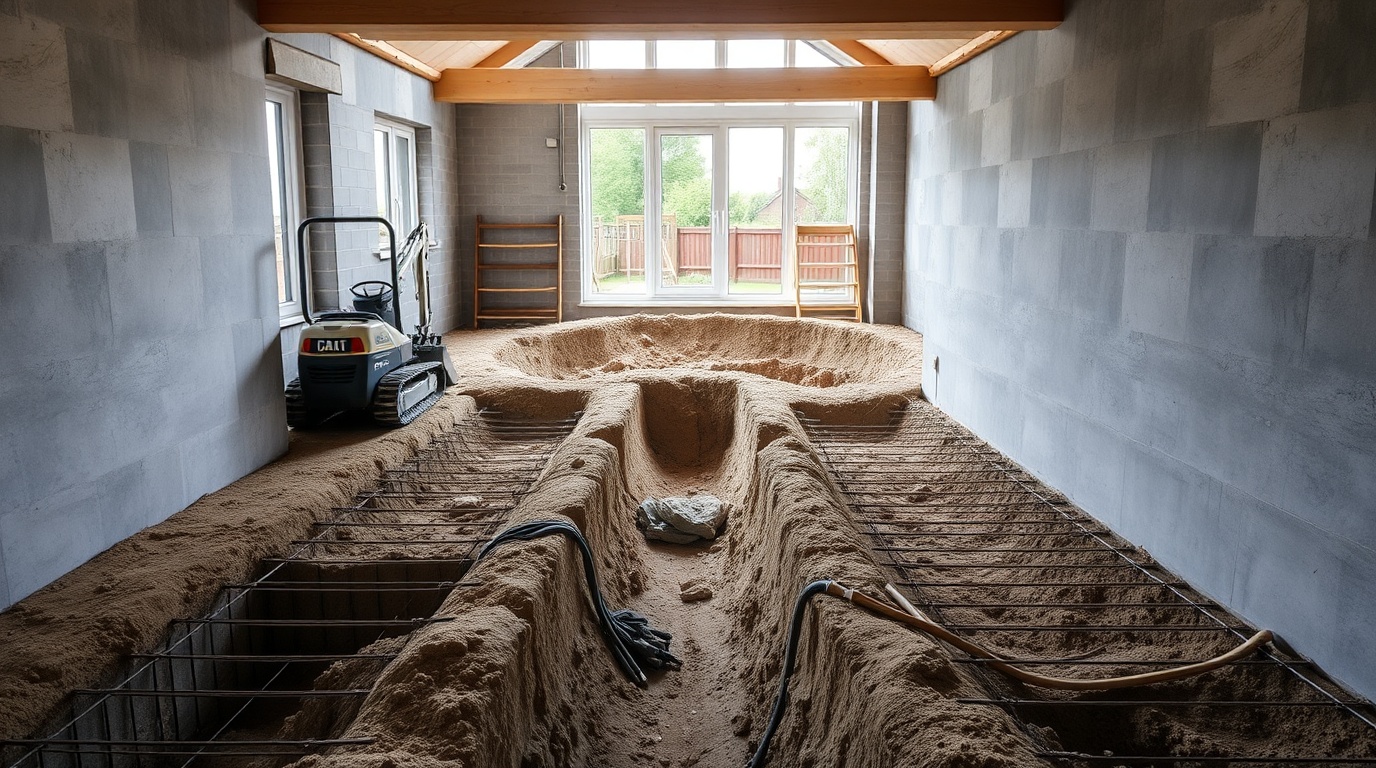
Pile foundations are slender columns — concrete or steel — driven, bored or screwed into the ground to carry a building's load down to a firm stratum below soft, shrinkable or made-up soil, with the piles tied together at the top by reinforced concrete ground beams that the walls are built off. You need them when conventional trenches would be uneconomic or risky: deep shrinkable clay near trees, deep made-up ground, a high water table, or sites where digging is impractical. Piling is always an engineer-designed solution and is more specialist than a strip footing, so it costs more — typically several thousand pounds for a domestic extension and well into five figures for larger or deeper jobs. As a structural foundation it must satisfy Part A and is inspected by Building Control.
Piling sounds dramatic, but on the right site it is the most economical answer. Here is how piles work and the conditions that call for them.
Pile foundations
- What they doReach firm soil below bad ground
- Topped byReinforced ground beams
- Common typesBored, driven, screw (helical)
- Typical useClay near trees, fill, high water
- DesignStructural engineer required
The main types of pile
- Bored (CFA) piles: a hole is augered and filled with concrete and reinforcement. Common on domestic sites because they are relatively low-vibration and suit clay.
- Driven piles: precast concrete or steel sections hammered into the ground. Fast, but the vibration and noise can be an issue near existing buildings.
- Screw / helical piles: steel shafts with a helical plate wound into the ground. Quick, low-vibration and good for restricted access or lighter loads such as garden rooms.
Whatever the type, the piles are linked at the surface by reinforced ground beams so the load is shared and the walls have a continuous base to build from.
When an extension actually needs piling
Piling becomes the sensible option where trenches would have to go very deep or where the ground simply will not carry a shallow footing.
| Condition | Why piling helps |
|---|---|
| Deep shrinkable clay near trees | Avoids 2.5–3m+ trench fill |
| Deep made-up / fill ground | Reaches firm stratum below |
| High water table | Avoids working in flooded trenches |
| Restricted access / heave risk | Low-vibration mini-piling options |
Indicative guidance only; the engineer's site assessment decides. Sources: NHBC Standards Chapter 4; LABC guidance.
Cost, design and sign-off
Piled foundations are quoted by a specialist and depend on the number, depth and type of piles plus the ground beams. For a domestic extension expect a figure that starts in the low thousands and rises into five figures for larger, deeper or restricted-access jobs. A structural engineer designs the pile layout and beams from a ground investigation, and the design forms part of your Building Regulations submission. Building Control will want evidence the piles were installed to the design (depths, sets or torque) and will inspect the ground beam reinforcement before concrete. Because piling is specialist, use a contractor experienced in domestic mini-piling rather than treating it as ordinary groundworks.
Access, vibration and the neighbour question
On a tight domestic plot, the practical constraints often matter as much as the engineering. Full-size piling rigs cannot reach many back gardens, which is why mini-piling rigs — compact machines that fit through a standard side passage — are common on extensions. The pile type is then chosen partly around access and partly around the effect on neighbours and the existing house:
- Vibration: driven piles are hammered in and can transmit vibration to adjacent buildings; bored (CFA) and screw piles are far quieter and lower-vibration, so they are usually preferred next to existing or shared walls.
- Heave and spoil: bored piles produce arisings (spoil) that must be removed, and on contaminated ground that adds disposal cost; screw piles produce little spoil.
- Headroom: low-headroom rigs exist for work close to a building, but restricted access generally slows the job and raises the price.
It is also worth checking the Party Wall etc. Act 1996: foundation work close to a boundary or shared wall — including piled ground beams — can require a party wall notice to the neighbour before work starts. None of this changes the structural case for piling, but it shapes the method, the cost and the programme, so raise access and neighbour issues with the engineer and piling contractor at design stage rather than on the day the rig arrives.
Ground beams, the floor, and how the load actually travels
It helps to understand what sits on top of the piles, because a pile on its own carries nothing useful — it is the ground beam system that turns a row of piles into a foundation. Reinforced concrete ground beams span between the pile heads, and the walls are built off the beams, so the load path runs wall to beam to pile to firm stratum, bypassing the soft ground entirely.
- Suspended floor: the ground-bearing slab you would use on good soil is usually replaced by a suspended floor spanning between the beams — commonly a beam-and-block or a reinforced slab — so the floor is not relying on the poor ground either.
- Void or compressible layer: on shrinkable clay or heave-prone ground, a void former or compressible layer is placed beneath beams and floor so the clay can swell without pushing up on the structure.
- Service entries: drains and services passing through or under the beams need planning so they are not damaged by movement and remain accessible.
This is why piling is never just "the piles" on a quote: the ground beams, the suspended floor and the movement precautions are an integral part of the design and the cost. The engineer details all of it together, and Building Control inspects the reinforcement and the pile records before concrete, so the finished foundation behaves as one coordinated structure rather than a set of separate parts.
Frequently asked questions
Are pile foundations expensive?
They cost more than a strip footing because of the design fee and specialist plant, typically from the low thousands up into five figures for a domestic extension. On bad ground, though, they are often cheaper than very deep trench fill.
What is the difference between piles and a raft?
A raft spreads load over a slab near the surface; piles transfer load down to a firm stratum below poor ground. Rafts suit variable surface ground, piles suit deep soft or shrinkable ground.
Do screw piles need Building Control approval?
Yes. Any foundation supporting habitable structure must satisfy Part A and is part of your Building Regulations application, with the installation evidenced and inspected. An engineer designs the layout.
Sources & further reading
- NHBC — Standards Chapter 4 (foundations)
- LABC — foundations and Building Control
- Planning Portal — Approved Document A (structure)
Figures on this page are typical UK ranges drawn from published sources and depend on your specific site. They are guidance, not a quotation.