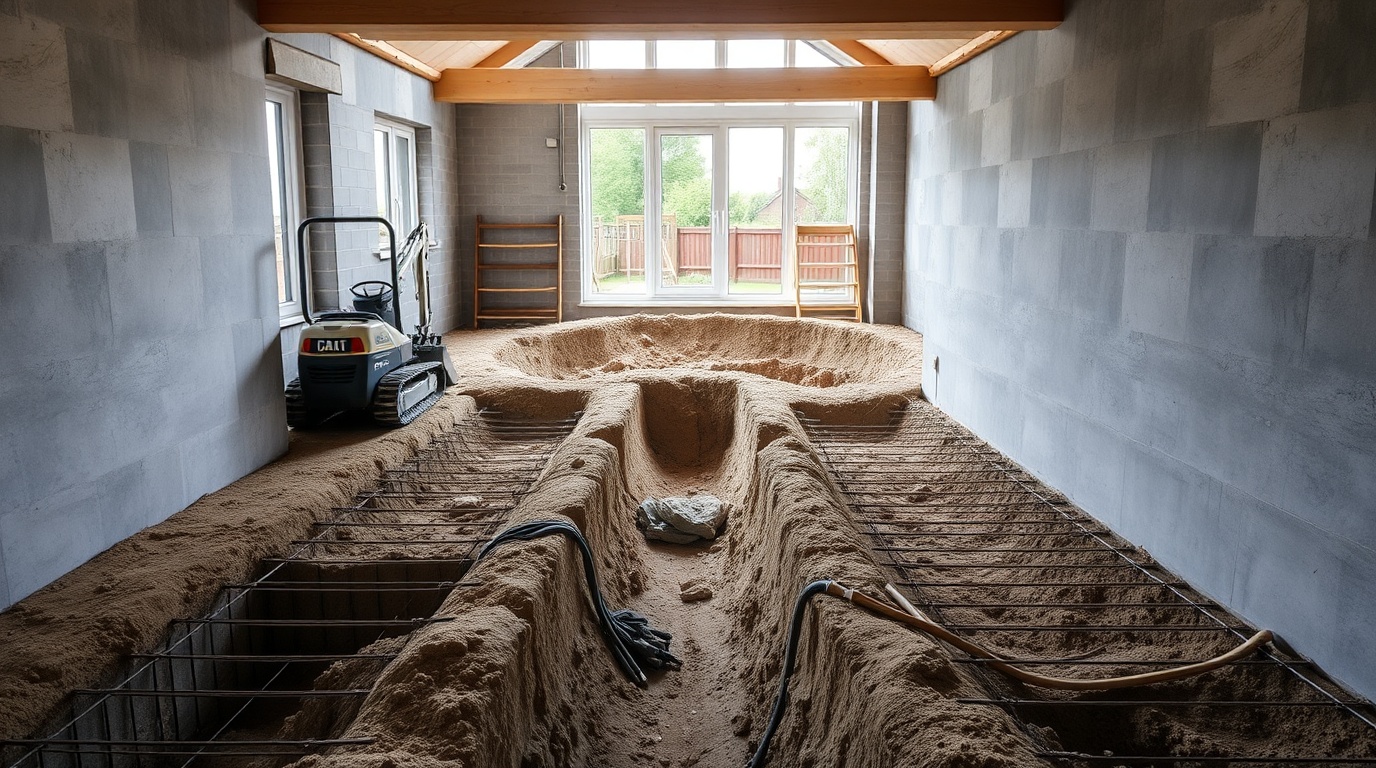
The short answer
A traditional strip foundation is a relatively thin band of concrete (often around 150–300mm) cast at the bottom of the trench, with brick or block masonry built up from it to ground level. A trench fill foundation instead fills almost the entire trench with concrete, stopping a couple of courses below ground, so there is little or no below-ground masonry. Strip uses less concrete but more labour and time bricklaying in a deep trench; trench fill uses much more concrete but is faster and safer because workers spend less time in a deep, open excavation. On shallow firm ground, strip is often cheaper; once trenches go beyond roughly 1m, trench fill usually wins on overall cost and speed. Both must meet Part A and are inspected by Building Control before the pour.
Strip and trench fill are not rival technologies — they are two ways to deal with the same trench. The right choice is mostly about how deep you have to dig.
Strip vs trench fill
- Strip concreteThin footing, masonry above
- Trench fill concreteTrench filled near to top
- Strip best forShallow, firm ground
- Trench fill best forDeeper trenches, clay
- Both signed off byBuilding Control, open trench
How each one is built
- Traditional strip: dig the trench, pour a concrete footing in the base, then lay brick or block from the footing up to damp-proof course level. More steps, more bricklaying, but less concrete volume.
- Trench fill: dig the trench, then pour concrete to fill it almost to the surface, leaving only a course or two for the masonry transition. Fewer steps, far less below-ground bricklaying, more concrete.
Both rely on the trench reaching firm, undisturbed ground at the depth required by your site, and both are checked by Building Control before any concrete goes in.
Cost and speed trade-off
The economics swing on depth. In a shallow trench, the extra concrete in trench fill outweighs the saved bricklaying, so a traditional strip is often cheaper. In a deep trench — common on clay or near trees — bricklaying below ground becomes slow, awkward and costly, and a person working at depth raises safety concerns, so trench fill is usually faster and cheaper overall despite the concrete volume.
| Factor | Traditional strip | Trench fill |
|---|---|---|
| Concrete used | Less | More |
| Below-ground bricklaying | More | Little / none |
| Speed | Slower | Faster |
| Best when trench is | Shallow | Deep |
Indicative comparison for guidance. Actual cost depends on depth, ground and access. Sources: NHBC Standards Chapter 4; Checkatrade foundation cost guides.
Which one will you actually use?
For a typical UK extension, the depth needed to reach firm ground usually makes the decision. Shallow, well-drained, tree-free ground tends to favour a strip footing. Shrinkable clay, nearby trees or sloping ground that forces a deeper trench tends to favour trench fill. Your builder will price the option that suits the depth, and Building Control will confirm the design is adequate when they inspect the open trench. On difficult ground, neither may be suitable and a raft or piled solution is designed by a structural engineer instead.
Buildability, safety and concrete supply
Beyond raw cost, three practical issues often tip the choice towards trench fill on deeper jobs. The first is safety: working in a deep, narrow trench to lay bricks below ground is hazardous, and the longer anyone spends down there, the greater the risk of collapse — trench fill minimises that time by replacing below-ground bricklaying with a single pour. The second is speed and weather exposure: an open trench left for days while masonry is built up is vulnerable to rain, frost and partial collapse, whereas filling it quickly gets the foundation in and the trench backfilled sooner. The third is concrete logistics: trench fill needs a larger, well-planned pour, often using ready-mixed concrete and sometimes a pump for poor access, so it pays to order the right volume and grade and to have the trench inspected and ready before the lorry arrives.
Strip footings, by contrast, suit smaller or self-build jobs where the trench is shallow, concrete is being mixed on site, and the bricklaying below ground is quick and safe. Neither approach changes the fundamentals of getting to firm ground at the right depth and width; they simply trade concrete volume against labour and time. Whichever is chosen, the foundation must be designed and built to Part A, with the open trench inspected by Building Control before any concrete is placed.
Concrete volume, the break-even depth, and reinforcement
The reason depth decides the choice comes down to a simple trade-off between concrete volume and below-ground bricklaying. Trench fill replaces all that buried masonry with concrete, so as the trench gets deeper the bricklaying you avoid grows faster than the extra concrete costs — there is a rough break-even depth, often around a metre, beyond which trench fill becomes the more economic option even though it pours far more concrete. Below that depth, a thin strip footing with masonry built up is usually cheaper because the concrete saving outweighs the modest bricklaying.
A few practical details sit alongside that headline:
- Concrete grade and volume: trench fill needs a well-planned pour of the right grade, often ready-mixed and sometimes pumped for poor access; ordering the correct volume avoids costly part-loads or a short pour.
- Reinforcement: most domestic strip and trench fill is plain (unreinforced) concrete, but on variable ground, over short soft spots, or where a foundation must bridge a localised weakness, the engineer may call for steel — which narrows the cost gap.
- Stepping on slopes: both types are stepped down a sloping site; trench fill steps are simply formed in the concrete, which can be quicker than building masonry steps in a strip.
- Ground movement: in clay near trees, the deep trench that trench fill suits is exactly the situation that arises, which is why the two so often go together.
None of this changes the fundamental job — reaching firm, undisturbed ground at the right depth and width — but it explains why an experienced groundworker will price trench fill on a deep, tree-affected plot and a strip on shallow, firm, open ground, and why the open-trench inspection under Part A matters whichever is used.
Frequently asked questions
Is trench fill more expensive than strip?
It uses more concrete, so on a shallow trench it can cost more. But in a deep trench it saves so much below-ground bricklaying and time that it is usually cheaper overall. Depth is the deciding factor.
Which is stronger, strip or trench fill?
Both are designed to carry the load adequately when built correctly to Part A. Trench fill is not inherently stronger; it is chosen for speed and safety in deep excavations rather than extra strength.
Do I choose strip or trench fill myself?
Usually your builder recommends one based on the trench depth your ground requires, and Building Control confirms it is adequate at the trench inspection. On difficult ground an engineer may specify a different foundation altogether.
Sources & further reading
- NHBC — Standards Chapter 4 (foundations)
- Planning Portal — Approved Document A (structure)
- Checkatrade — foundation cost guide
Figures on this page are typical UK ranges drawn from published sources and depend on your specific site. They are guidance, not a quotation.