The short answer
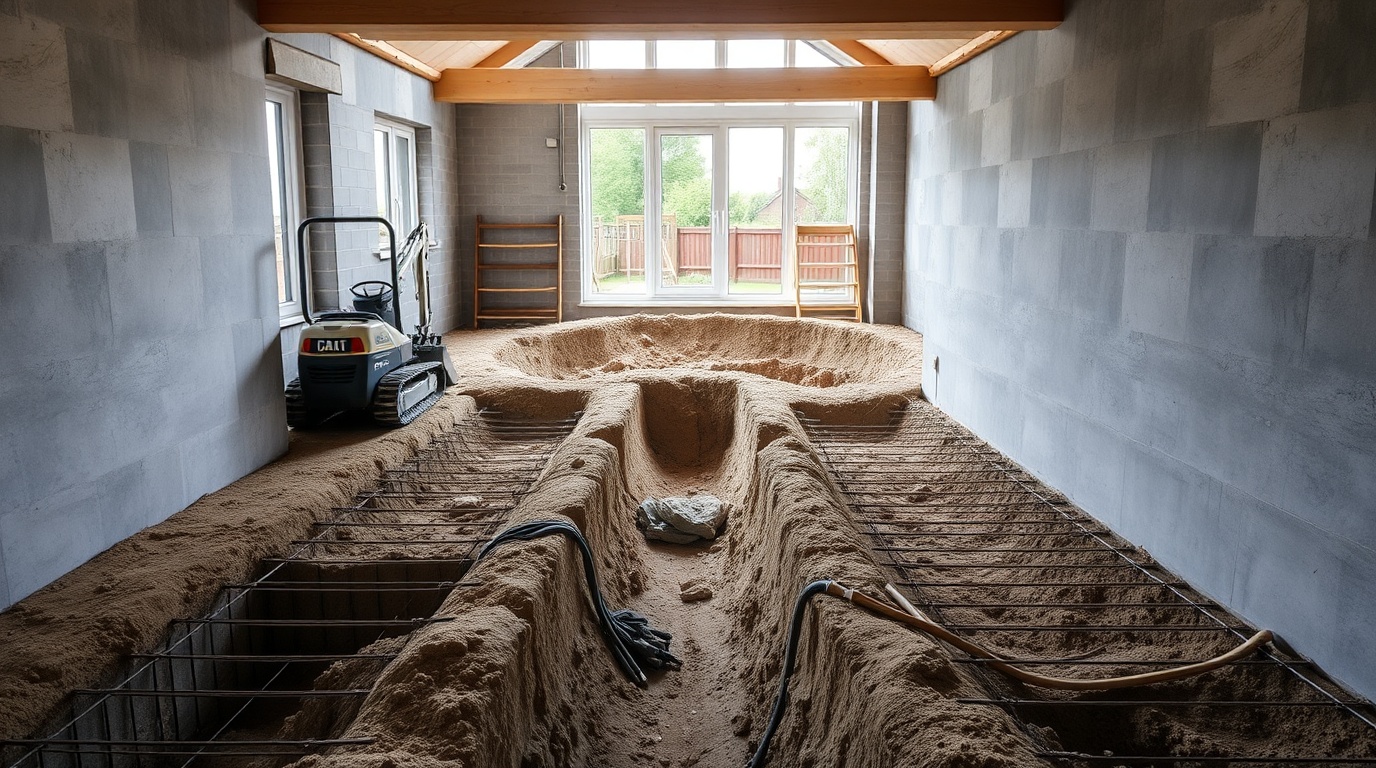
Foundation width is set by the wall load and the bearing capacity of the soil: the weaker the ground, the wider the footing must be to spread the load to an acceptable pressure. For a typical single- or two-storey extension on reasonable ground, strip and trench fill widths are commonly around 450–600mm, but firmer ground can allow less and weaker ground needs more. There are also practical and regulatory minimums — the concrete must project beyond each face of the wall, often by at least the thickness of the concrete or a set amount, and trench fill is frequently the width of the digger bucket. The governing rule is Part A of the Building Regulations, and the width on the drawing is provisional until Building Control confirms the actual ground in the open trench.
Width gets less attention than depth, but it is just as important: too narrow and the soil pressure is too high. Here is what sets it.
Foundation width
- Typical strip width~450–600mm
- Set byWall load + soil bearing
- Weaker groundWider footing
- Trench fillOften bucket width
- Confirmed byBuilding Control, open trench
What sets the width
- Wall load: a heavier wall (two storeys, masonry, with floor and roof loads) needs a wider base to spread the load.
- Soil bearing capacity: firm gravel carries far more pressure than soft clay, so weaker soils need wider footings to keep the pressure within safe limits.
- Projection rule: the concrete must extend beyond each face of the wall it supports, so the footing is always wider than the wall by a margin on each side.
- Buildability: trench fill is often dug to a standard excavator bucket width (commonly around 450–600mm), which usually exceeds the structural minimum.
Typical widths by situation
The figures below are indicative starting points. The actual width comes from the structural design and is confirmed against the real ground when the trench is inspected.
| Situation | Indicative width | Notes |
|---|---|---|
| Single-storey, firm ground | ~450mm | Often bucket width |
| Two-storey, firm ground | ~600mm | Heavier load |
| Soft / weak soil | Wider | Spreads load further |
| Trench fill (general) | Bucket width | Usually exceeds minimum |
Indicative guidance only; width is set by design and confirmed in the trench. Sources: Planning Portal Part A; NHBC Standards Chapter 4.
How width is confirmed
Width forms part of the foundation design submitted with your Building Regulations application. Building Control checks the open trench before the pour, confirming the width and the firmness of the bearing soil at the design level. On weak or variable ground, a structural engineer may specify a wider footing, a reinforced strip, or a different foundation type altogether (such as a raft) to keep ground pressures acceptable. As with depth, never pour until the trench width and bearing have been inspected and accepted.
When a wider footing is not the answer
It is tempting to think a problem with soft ground can always be solved by simply digging the footing wider, but there is a limit to that logic. Widening a plain concrete strip works only up to a point: once the footing has to project a long way beyond the wall, the concrete itself can fail in bending or shear unless it is made thicker or reinforced. Beyond that, the economical answer is usually a different foundation altogether.
- Reinforced strip / wide-toe footing: adding steel lets a footing spread wider without becoming uneconomically thick — designed by an engineer.
- Raft: where the whole footprint sits on weak or variable ground, spreading the load across a single reinforced slab is more effective than ever-wider individual footings.
- Piles: where no firm bearing exists near the surface at any sensible width, the load is taken down to a firm stratum instead.
Width also interacts with depth: a footing must be both deep enough to reach firm ground and wide enough to spread the load on that ground without overstressing it, and on a sloping site it must do so while being stepped so each length stays in sound soil. This is why width is part of a coordinated structural design rather than a number picked in isolation. For a typical extension on reasonable ground a sensible strip or trench fill width settles the matter; on poorer ground, an engineer balances width, depth, reinforcement and foundation type together so the soil pressure stays within safe limits and the concrete itself is not overstressed.
The projection rule and why bearing capacity is the real number
Two ideas sit behind every width figure, and understanding them makes the drawings far less mysterious. The first is the projection: the concrete has to extend beyond each face of the wall it supports, because the load spreads outwards from the wall into the footing at roughly 45 degrees through the concrete. If the footing projects too far for its thickness, the unsupported edge tries to bend off and the plain concrete can crack — which is why a wider footing usually has to be thicker, or reinforced, rather than just wider.
The second, and the one that really sets the width, is the soil's bearing capacity — how much pressure the ground can take without settling. The footing width is chosen so that the total wall load, divided by the area of soil under the footing, stays comfortably below that safe bearing pressure. Firm gravel might carry several times the pressure of soft clay, so the same wall needs a much wider footing on the weaker soil.
- Heavier wall, wider footing: a two-storey masonry wall with floor and roof loads needs more bearing area than a single-storey one.
- Weaker soil, wider footing: low bearing capacity is spread over more ground to keep the pressure safe.
- Eccentric loads: where a wall sits off-centre on its footing (near a boundary, for instance), the design may need a wider or reinforced footing to avoid uneven pressure.
Because the safe bearing pressure is an assumption until the trench is open, the width on the drawing is provisional. Building Control checks the real ground at the inspection and can call for a wider footing if the soil is softer than expected, which is a normal part of getting the foundation right rather than a sign of a mistake.
Frequently asked questions
What is the minimum width for extension foundations?
There is no single national figure. Width is set by wall load and soil bearing, plus a projection beyond each face of the wall. Typical strip widths are around 450–600mm, wider on weaker ground, confirmed by Building Control.
Does a two-storey extension need wider foundations?
Usually, yes. A two-storey wall carries more load than a single-storey one, so the footing generally needs to be wider (and the ground checked carefully) to keep soil pressure within safe limits.
Why is trench fill dug to bucket width?
It is practical: the excavator bucket sets a consistent trench width, and that width usually meets or exceeds the structural minimum. The engineer confirms it is adequate for the load and ground.
Sources & further reading
- Planning Portal — Approved Document A (structure)
- NHBC — Standards Chapter 4 (foundations)
- LABC — building an extension
Figures on this page are typical UK ranges drawn from published sources and depend on your specific site. They are guidance, not a quotation.