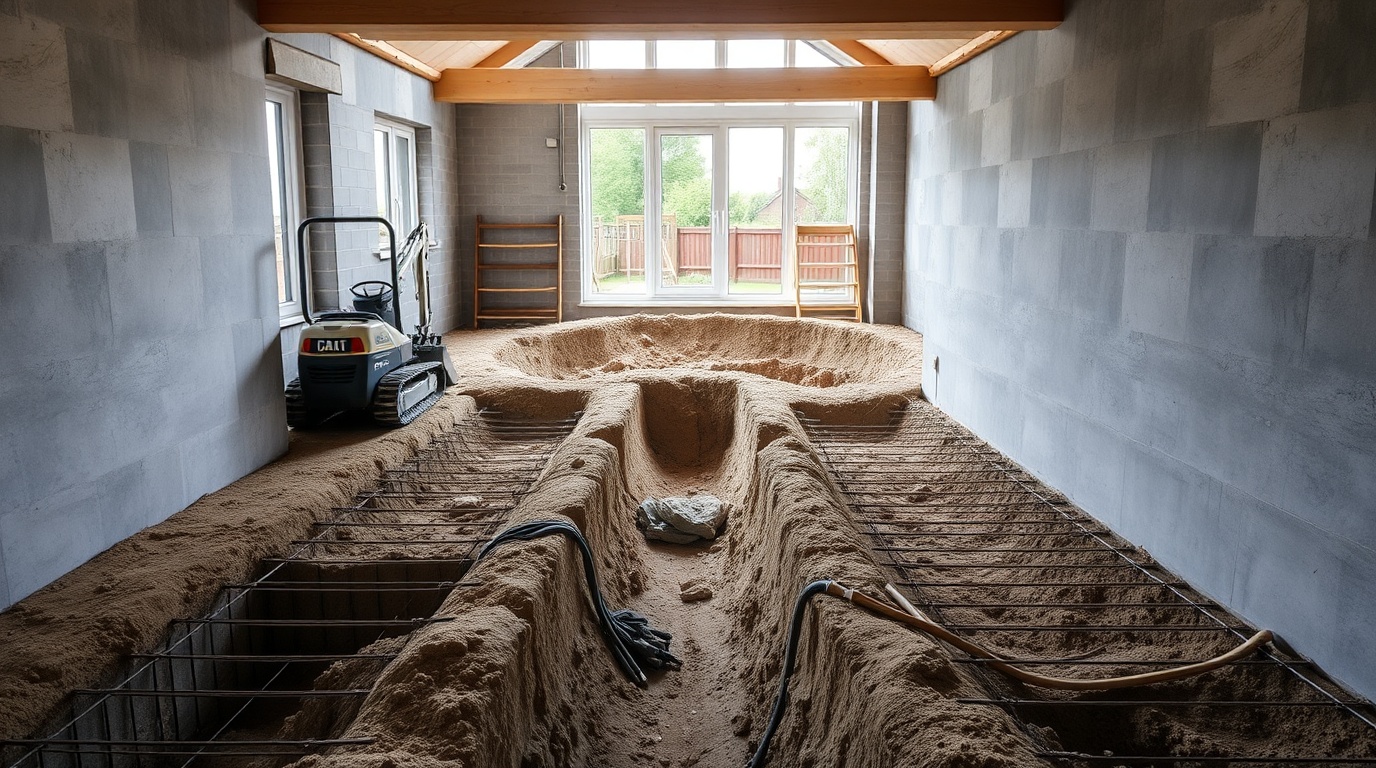
The short answer
Digging out for a typical single-storey UK extension — excavating the foundations and reducing the floor area — commonly costs around £2,000–£6,000 for the groundworks dig and muck away alone, before concrete and the rest of the foundations. The figure rises with footprint, foundation depth and ground conditions: a small 3 m × 4 m extension on good ground sits at the lower end, while a larger footprint, deep footings near trees, or restricted rear-garden access push it higher. Most of the cost is excavation time and muck away — a digger and operator at roughly £300–£600 a day plus grab-lorry loads at £250–£400 each. Building Control will dictate foundation depth, and trees, drains or clay can force deeper, costlier digs.
The dig-out is the groundworks stage of an extension: excavating foundation trenches and reducing the floor level. The figures below are typical UK ranges for that work, before the concrete and build above.
Typical UK costs
- Dig-out + muck away (single storey)£2,000–£6,000
- Digger + operator£300–£600 / day
- Grab lorry load£250–£400
- Foundation depthset by Building Control
- Near trees / claydeeper, costlier
What the dig-out covers
"Digging out" for an extension usually means two related excavation tasks:
- Foundation trenches: excavating along the line of the new walls to the depth required by Building Control, ready for concrete footings.
- Floor reduction: taking the internal floor area down to formation level so the sub-base, insulation and slab (or beam-and-block floor) can be built up.
Both generate spoil that has to be removed. The dig-out is only part of the foundation cost — the concrete, reinforcement, blockwork up to damp-course and the floor build-up follow — but it is the part most affected by ground and access, so it is where quotes vary most.
It is also worth separating the two tasks mentally, because they scale differently. The trench dig follows the perimeter of the new walls and its cost rises mainly with depth — deeper footings near trees mean a lot more spoil along the same length. The floor reduction covers the whole internal area and its cost rises mainly with footprint. A small, deep-footing extension on clay can therefore be dominated by the trenches, while a large, shallow extension on good ground is dominated by the floor reduction. Knowing which applies to your job helps you read the quote.
| Item | Typical figure | Notes |
|---|---|---|
| Dig-out + muck away | £2,000–£6,000 | single-storey, before concrete |
| Digger + operator | £300–£600 / day | size suited to access |
| Muck away (grab load) | £250–£400 | ~14–16 tonnes |
| Deep footings near trees | adds significantly | depth set by engineer/BC |
Indicative UK figures for guidance. Sources: Checkatrade and MyBuilder extension and groundworks cost guides.
Foundation type and depth
How deep you dig is not your choice — Building Control and, where needed, a structural engineer set the foundation depth based on the soil, nearby trees and the structure above. Two common approaches affect the dig:
Strip foundations use a relatively shallow trench with a concrete strip on which the walls are built, suiting stable ground. Trench fill digs a narrower, deeper trench and fills almost the whole depth with concrete; it uses more concrete but less labour and is common on clay or near trees, where foundations must go deeper. Proximity to trees is a frequent reason for deeper digs, because shrinkable clay soils move as trees take up moisture, and the foundation must reach below that zone of influence — sometimes well over a metre, occasionally much more.
Access, ground and muck away
Because most extensions are at the rear of a house, access is often the biggest cost driver. If a digger and grab lorry can reach the back garden, the work is efficient. If the only route is through the house or a narrow side passage, a smaller machine — or hand digging — is needed, and spoil may have to be barrowed out, all of which is slower and dearer. A skip on the drive plus barrowing is common on tight urban plots.
Ground conditions change the dig too: heavy clay is slow and sticky, rock may need a breaker, and a high water table means pumping and possibly shoring the trench sides for safety. As with all excavation, muck away — haulage and tipping plus Landfill Tax — often costs more than the digging, and deeper foundations near trees mean more spoil to remove. A site visit, plus the foundation depth from Building Control, is the only reliable basis for a firm figure; the ranges here are for planning the budget.
Where the dig-out sits in the overall cost
It helps to see the dig-out as one stage of the wider groundworks, because the stages that follow are where much of the remaining budget goes. A typical single-storey extension groundworks sequence runs:
- Dig out the foundation trenches and reduce the floor area, removing spoil.
- Pour foundations — strip footings or trench fill — once Building Control has inspected the open trench.
- Build up to damp-course in blockwork, with any cavity detailing.
- Form the floor — compacted sub-base, membrane, insulation and a slab, or a beam-and-block floor.
- Run drainage connections where the extension needs them.
The dig-out is usually a smaller slice of the total groundworks than the concrete and floor build that follow, but it is the slice most exposed to nasty surprises — soft ground, buried obstructions, a drain in the wrong place — so it is where a contingency is most useful. Pricing the whole sequence rather than the dig alone gives a truer picture of the groundworks budget.
Frequently asked questions
How deep do extension foundations need to be?
There is no single figure — Building Control sets the depth from the ground type, the load and nearby trees. On stable soil away from trees, foundations may be relatively shallow; on shrinkable clay or close to trees they often go beyond a metre, sometimes much deeper, which increases both the dig and the concrete cost.
Does the dig-out cost include the concrete foundations?
Usually not — check the quote. The dig-out covers excavation and muck away; the concrete footings, reinforcement, blockwork up to damp-course and the floor build-up are separate items. Because they are priced separately, always confirm exactly what a groundworks quote includes before comparing figures.
Why does rear-garden access make an extension dig more expensive?
If a full-size digger and grab lorry cannot reach the back of the house, the work shifts to a mini-digger or hand digging, and spoil has to be barrowed out, often into a skip on the drive. This is slower and needs more labour, so the same dig costs more on a plot with restricted access.
Sources & further reading
- Checkatrade — extension foundations / groundworks cost guide
- MyBuilder — groundworks cost guide
- GOV.UK — building regulations approval
Figures on this page are typical UK ranges drawn from published sources and depend on your specific site. They are guidance, not a quotation.