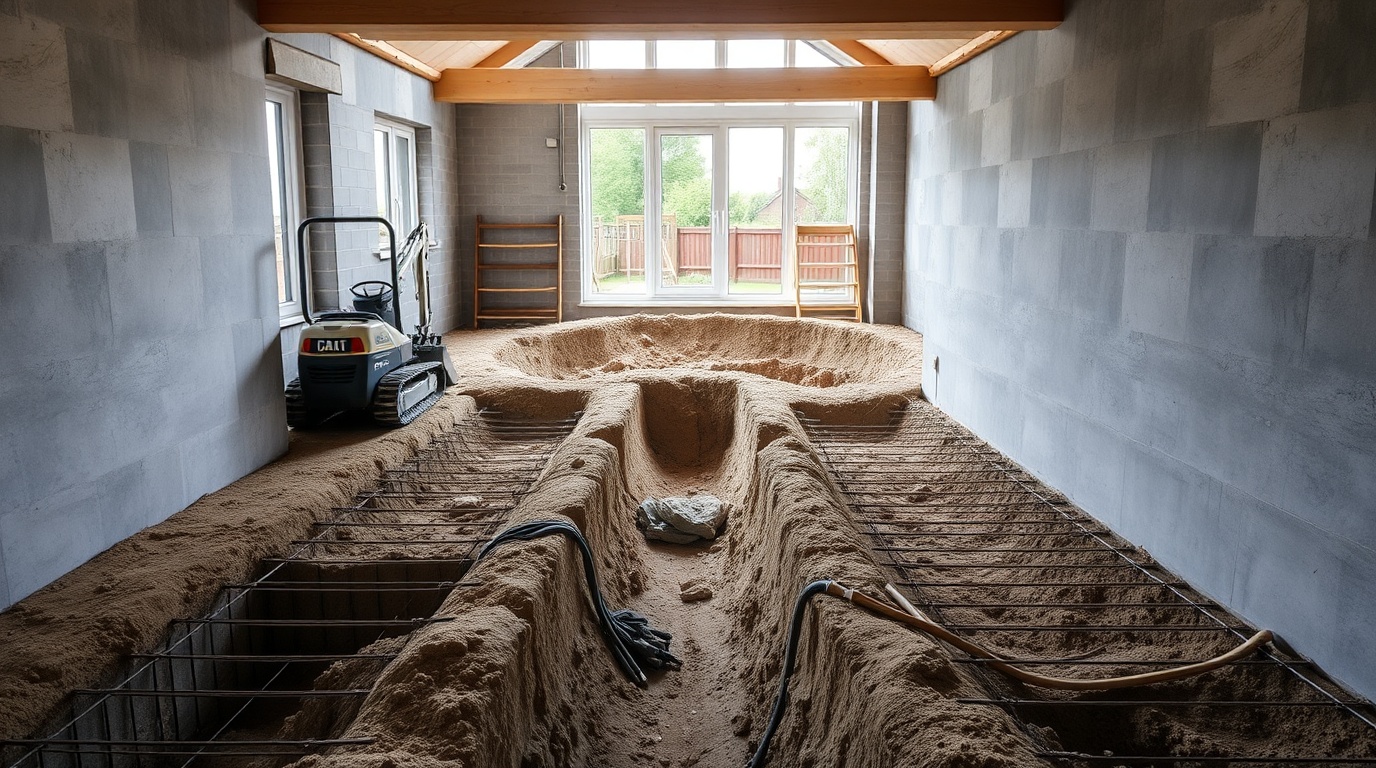
The short answer
Block and beam flooring in the UK typically costs £45–£90 per square metre supplied and fitted, with most domestic suspended ground floors around £55–£75/m². The rate covers the concrete beams, the infill blocks, the labour to lay them and a sand-cement grout brushed in. It excludes the insulation, screed or chipboard deck and any structural toppings, which are extra. Block and beam is a suspended ground floor that bridges between supporting walls, used widely on new builds and extensions where the ground is sloping, made-up, or prone to movement. The floor must meet Building Regulations Part A and Part L for structure and insulation.
Beam and block is the standard suspended ground floor across much of UK housebuilding, chosen for speed and its tolerance of poor or sloping ground. It is priced per square metre, but the bare-floor rate is only part of the finished cost. The sections below break it down and compare it to a slab.
At a glance
- Beams + blocks fitted~£55–£75/m²
- Full range~£45–£90/m²
- ExcludesInsulation, screed/deck
- Floor typeSuspended ground floor
- Good forSloping / unstable ground
Typical block and beam costs
The per-square-metre rate for beam and block covers the structural floor itself: the precast concrete T-beams that span between supporting walls, the lightweight infill blocks laid between them, and the grout brushed over to lock it together. The finishing layers above — insulation, then a screed or floating chipboard deck — are separate costs that roughly double the rate to a finished floor. The table shows the structural rate and the typical additions.
| Item | Indicative cost per m² | Notes |
|---|---|---|
| Beams + blocks, fitted | £55–£75 | Structural floor only |
| Budget / simple span | £45–£60 | Standard layout |
| Complex / long span | £75–£90 | Deeper beams, awkward shape |
| + Insulation | £15–£35 | To meet Part L |
| + Screed or chipboard deck | £20–£45 | Finished floor surface |
Indicative figures for guidance only. Add insulation and a deck/screed for a finished floor.
What block and beam includes and how it is built
A beam-and-block floor is a suspended ground floor: precast concrete beams span between the substructure walls, with concrete infill blocks dropped into the gaps between them, then the whole deck is grouted with a sand-cement slurry brushed in to bind it. A ventilated void is left below the floor, with airbricks in the perimeter walls allowing air to circulate and keeping the underside dry. This is why it suits ground that a slab cannot — the floor is not bearing on the soil, so ground movement, slope or fill below it does not crack the floor.
The structural deck on its own is not a finished floor. To meet Part L it needs insulation laid over (or sometimes within) the deck, and to be usable it needs a surface — either a sand-cement or liquid screed, or a floating chipboard deck on the insulation. These layers are usually priced separately, which is why a beam-and-block rate can look cheaper than a slab at first glance but ends up similar once the floor is genuinely finished. When comparing quotes, the key is to check whether the figure is the structural deck only or a finished floor including insulation and a surface.
Why the ventilated void matters
The feature that defines a beam-and-block floor, and explains much of where it is used, is the ventilated void left beneath it. Because the floor spans between walls rather than sitting on the soil, there is an air gap underneath, and airbricks set into the perimeter walls let air flow through it. This continuous ventilation keeps the underside of the floor dry, prevents condensation and damp building up, and is a requirement of the design rather than an optional extra — the airbricks must be kept clear and not blocked by later landscaping or extensions.
That void brings several practical advantages that justify the floor type on certain sites. It allows the floor to cope with ground gas such as radon, because the ventilated space disperses gas before it can enter the building, which is valuable in radon-affected areas. It lets the floor bridge over poor or variable ground without bearing on it, so seasonal movement in clay or settlement in fill does not crack the floor. It provides a clear route for services to run beneath the floor. And it tolerates a slope, since the supporting walls can be built to different heights to keep the floor level while the ground falls away beneath. These are the situations where beam and block earns its slightly higher complexity over a ground-bearing slab — the void does work that a slab simply cannot, which is why the floor type is chosen on the merits of the ground rather than on the bare per-square-metre rate alone.
Block and beam versus a concrete slab
The main alternative to beam and block for a ground floor is a ground-bearing concrete slab. The choice usually comes down to the ground. A slab bears directly on a compacted sub-base and works well on firm, stable, fairly level soil. Beam and block spans between walls and ignores the ground below, so it is preferred where the soil is sloping, made-up, soft, or prone to movement, or where there is a deep void to bridge that would need expensive filling for a slab. It is also faster to lay over a large area and can be walked on almost immediately, with no curing wait.
On cost, the two are often broadly comparable once a slab's sub-base, membrane, insulation and concrete are added up against a finished beam-and-block floor's beams, blocks, insulation and screed. Where the ground is good and level, a slab can be the lower-cost option because it needs no precast components. Where the ground is poor, sloping or has a deep void, beam and block usually wins because a slab would need vast quantities of fill and compaction to reach the same result, or would crack as the ground moved. Beam and block also handles radon and ground gas well thanks to its ventilated void, and copes with services routed in the void below. The decision is best made on the ground conditions and the structural engineer's advice rather than on the headline per-metre rate alone, since the cheaper-looking option can carry hidden preparation costs that close the gap.
Frequently asked questions
Is block and beam cheaper than a concrete slab?
Not necessarily. The bare beam-and-block rate can look cheaper, but once insulation and a screed or deck are added, the finished cost is often similar to a slab. On poor or sloping ground beam and block usually wins; on good level ground a slab can be cheaper.
Does block and beam flooring need insulation?
Yes, if it forms the floor of a heated building. Insulation is laid over or within the deck to meet Building Regulations Part L, and is usually priced separately from the structural beams and blocks, so factor it into the finished cost.
Why use block and beam instead of a slab?
Because it spans between walls rather than bearing on the ground, it suits sloping, made-up, soft or unstable soil, bridges deep voids, ventilates against ground gas, and lays quickly over large areas. A slab is simpler and can be cheaper on firm, level ground.
Sources & further reading
- Checkatrade — flooring and groundworks cost guide
- Planning Portal — Building Regulations (Part L)
- NHBC — suspended ground floors
Figures on this page are typical UK ranges drawn from published sources and depend on your specific site. They are guidance, not a quotation.