The short answer
A raft foundation in the UK typically costs £130–£250 per square metre supplied and laid, with most domestic engineered rafts around £150–£220/m². A raft is a single reinforced concrete slab that spreads the whole building's load over the ground, used where the soil is poor, variable or where shallow strip footings would not work. It costs more per metre than a simple slab because of the heavy steel reinforcement, thicker edge beams and the structural engineer's design. The raft must be designed to Building Regulations Part A by a structural engineer and inspected by Building Control before the concrete is poured.
A raft spreads a building's load across its whole footprint rather than down narrow trenches, which makes it the go-to solution on weak or unpredictable ground. It is dearer per metre than a basic slab, for good reasons. The sections below explain the rate, when a raft is chosen, and what moves the cost.
At a glance
- Typical supplied + laid~£150–£220/m²
- Full range~£130–£250/m²
- Used forPoor or variable ground
- Key featureReinforced slab + edge beams
- RequiresEngineer design + Part A
Typical raft foundation costs
A raft costs more per square metre than a standard ground-bearing slab because it is a structural element carrying the entire building, not just a floor. It is thicker, heavily reinforced, often has stiffened edge and internal beams, and needs a structural engineer's design. The ranges below are indicative for a domestic raft; an industrial or heavily loaded raft, or one on very poor ground, sits at the top of the range or beyond.
| Raft type | Indicative cost per m² | Notes |
|---|---|---|
| Light domestic raft | £130–£170 | Reasonable ground, simple shape |
| Standard engineered raft | £150–£220 | Poor ground, edge beams |
| Heavy / deep-beam raft | £200–£250 | Very weak ground, high loads |
| Strip footing (for comparison) | £80–£130 | Good ground alternative |
| Piled raft | £250–£400+ | Worst ground, piles + raft |
Indicative figures for guidance only. Raft design and cost depend on ground and loads.
When a raft is used instead of strip footings
The choice between a raft and conventional strip or trench-fill footings is driven by the ground. Strip footings work well on firm, uniform soil that can carry the load through narrow trenches. A raft comes into its own where that is not possible: soft or variable ground where a strip footing would settle unevenly, made-up or filled ground, areas of mining or shrinkage, or sites where the soil only has bearing capacity if the load is spread over a wide area rather than concentrated in trenches.
A raft also avoids the very deep excavation that poor ground would otherwise demand for strip footings, which can be a decisive advantage. Digging strip footings two or three metres deep into weak soil generates huge volumes of expensive spoil and concrete; a raft sits near the surface and spreads the load instead, sometimes working out cheaper overall despite its higher per-metre rate. The decision is a structural engineering judgement based on a soil survey, not a preference — the engineer assesses the ground's bearing capacity and the building's loads and specifies whichever foundation suits. This is why a raft always comes with an engineer's design and Building Control involvement, and why you cannot simply choose a raft to save money without the ground justifying it.
How a raft is built
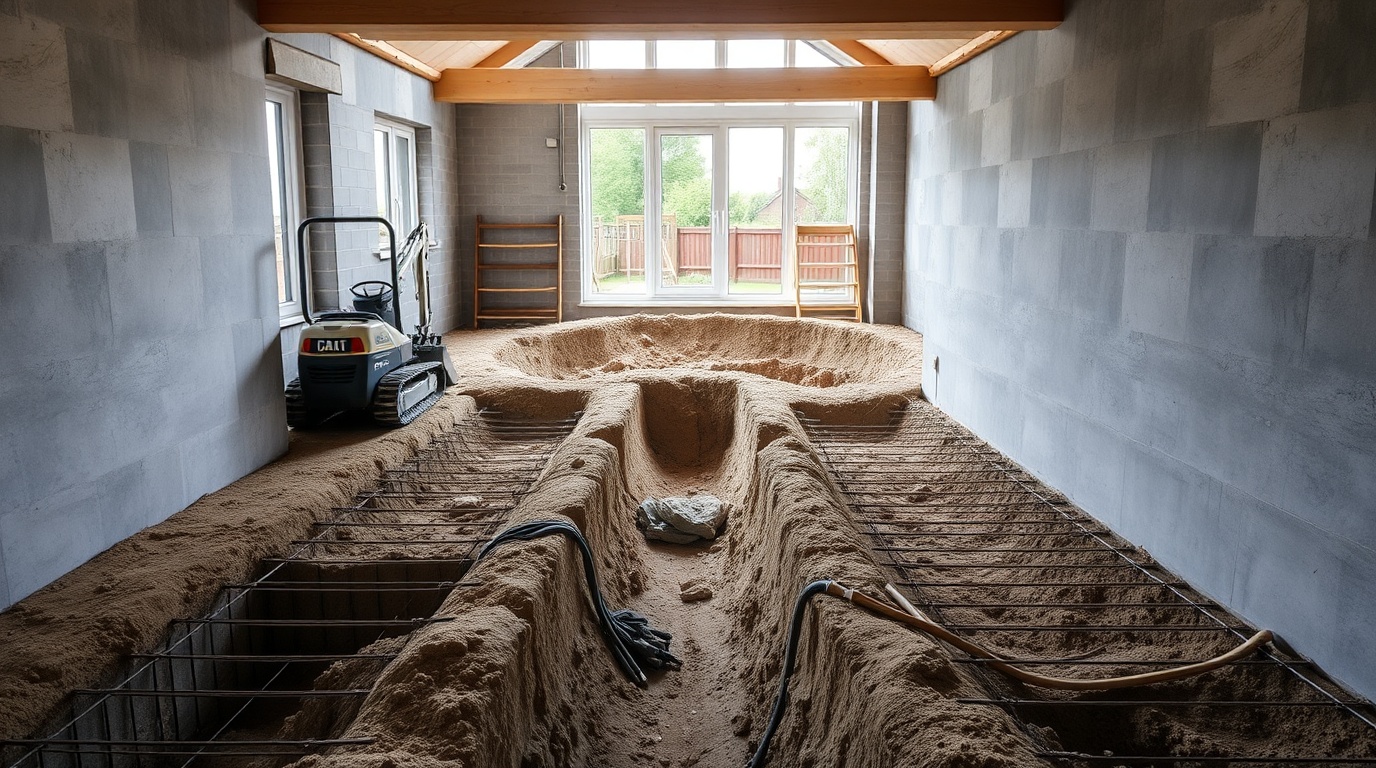
Understanding how a raft is constructed explains why it costs what it does. After the area is excavated to formation level, a compacted sub-base is laid and blinded to give a clean working surface. A damp-proof membrane goes down, then the reinforcement — typically two layers of steel mesh or rebar, top and bottom, tied together and into the deeper edge and internal beams that stiffen the slab. The whole assembly is then cast in one continuous concrete pour where possible, so the raft acts as a single rigid structure that spreads load evenly across the ground.
The thickened edge beams around the perimeter, and sometimes internal beams under load-bearing walls, are what let the raft distribute concentrated wall loads out across the whole footprint rather than punching through. This is the feature that makes a raft work on weak ground, and it is also why a raft uses so much more steel and concrete than a simple slab — the beams are deep, heavily reinforced sections cast integrally with the slab. The pour itself often needs a concrete pump and a well-organised crew to place a large volume continuously, since a cold joint in the wrong place would weaken the raft. All of this — the engineer's design, the heavy reinforcement, the deep beams and the large single pour — is why a raft sits well above a standard slab on a per-square-metre basis, and why it is always a designed, inspected structural element rather than a base you can lay informally.
What drives the raft cost
The raft rate is driven first by the engineer's design — the thickness, the amount and grade of steel reinforcement, and the depth and spacing of any stiffening beams, all set by the ground conditions and building loads. Weaker ground or heavier buildings need more steel and thicker concrete, raising the per-metre cost. Ground preparation matters too: a raft still needs a compacted sub-base and a level, well-prepared formation, and on very soft ground may need a stone blanket or geogrid beneath it.
Reinforcement is a major material cost — a raft uses far more steel than a simple slab, often two layers of mesh or rebar tied into the edge beams. Concrete volume is higher because the raft is thicker and the beams are deep. Area and shape affect efficiency: a simple rectangular raft is cheaper per metre than a complex outline with many corners and steps. Access determines how the concrete is placed — pumped or direct chute is far cheaper than hand-barrowing. And on the very worst ground, a piled raft combines the raft with piles driven to firmer strata below, which adds substantially to the cost but may be the only viable solution. Because a raft is always engineer-designed, the reliable way to understand its cost is the engineer's specification and a measured quote against it, rather than a generic per-metre figure.
Frequently asked questions
Is a raft foundation cheaper than strip footings?
Per square metre, no — a raft costs more because of its reinforcement and design. But on very poor ground where strip footings would need deep excavation and large volumes of spoil and concrete, a raft can be cheaper overall, which is often why it is chosen.
When do you need a raft foundation?
On soft, variable, made-up or filled ground, in areas of mining or shrinkage, or anywhere the soil only carries load if it is spread over a wide area rather than concentrated in trenches. A structural engineer decides based on a soil survey and the building loads.
Does a raft foundation need an engineer?
Yes. A raft is a structural element carrying the whole building, so it must be designed by a structural engineer to Building Regulations Part A and inspected by Building Control before the concrete is poured. It is not a foundation you can build without a design.
Sources & further reading
- Checkatrade — foundations cost guide
- Planning Portal — Building Regulations (Part A)
- The Concrete Centre — raft foundations
Figures on this page are typical UK ranges drawn from published sources and depend on your specific site. They are guidance, not a quotation.