The short answer
A concrete slab in the UK typically costs £65–£130 per square metre supplied and laid, with most domestic ground-bearing slabs around £80–£110/m². That covers excavation, a compacted sub-base, a damp-proof membrane, insulation, mesh reinforcement and the concrete itself, finished level. A thin, unreinforced slab on prepared ground can be lower at £50–£70/m²; a thick, reinforced or power-floated slab can reach £130–£180/m². The concrete should meet the appropriate strength grade for its use, and any slab forming part of a habitable building's floor must satisfy Building Regulations Part A and Part L for structure and insulation.
Per-square-metre is the natural way to price a concrete slab, but the rate swings widely depending on thickness, reinforcement and what is underneath. The sections below break the rate down, explain what is included, and show what pushes it up or down so you can read a quote properly.
At a glance
- Typical supplied + laid~£80–£110/m²
- Thin, unreinforced~£50–£70/m²
- Reinforced / power-floated~£130–£180/m²
- IncludesBase, membrane, mesh, concrete
- Floor in a buildingPart A + Part L apply
What the per-square-metre rate includes
A meaningful slab rate is supply-and-lay, covering the whole build-up rather than just the concrete. A typical ground-bearing slab is made of several layers, each adding to the per-metre cost. The table shows what a standard domestic slab usually involves and the indicative rates for different specifications. The thicker and more heavily reinforced the slab, and the more preparation underneath, the higher the rate.
| Slab type | Indicative cost per m² | Typical use |
|---|---|---|
| Thin, unreinforced (~100mm) | £50–£70 | Shed/light base, prepared ground |
| Standard ground-bearing | £80–£110 | Extension, garage floor |
| Reinforced (mesh/rebar) | £100–£140 | Heavier loads |
| Power-floated | £120–£160 | Smooth industrial finish |
| Thick / structural raft | £140–£180+ | Poor ground, engineered |
Indicative figures for guidance only. Rates vary with thickness, reinforcement and ground.
What the layers are and why they matter
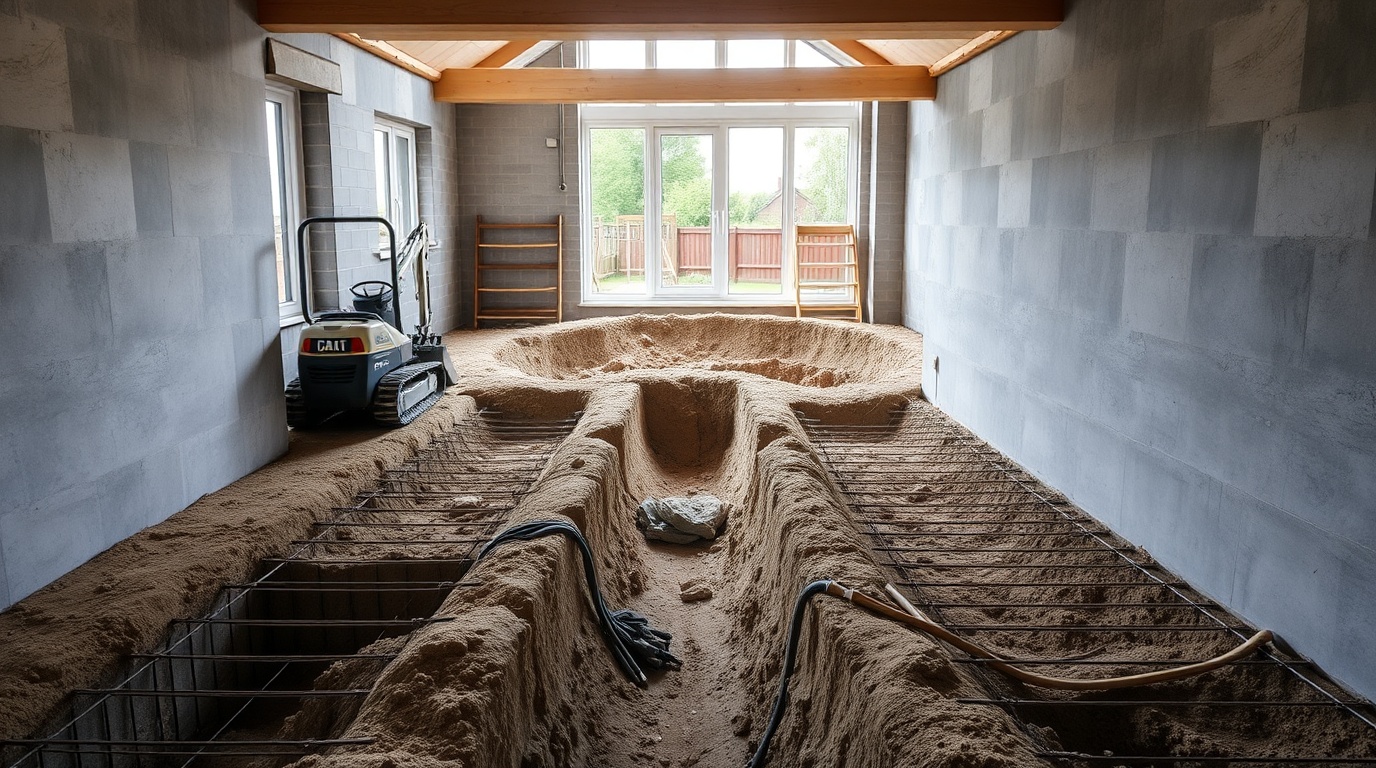
A proper ground-bearing slab is built up in layers, and each one affects both performance and cost. At the bottom is a compacted sub-base of crushed stone (often MOT Type 1), which spreads the load and gives a firm platform. Over that goes a damp-proof membrane to stop ground moisture rising into the floor, then usually rigid insulation where the slab is part of a heated building, to meet Part L. Reinforcement — steel mesh or, for heavier loads, rebar — is set within the concrete to control cracking and carry the load.
Finally comes the concrete itself, specified to a strength grade suited to its use and finished level, tamped or power-floated. Leaving out a layer to save money is a false economy: a slab with no membrane lets damp through, one with too little sub-base or no reinforcement cracks and sinks, and one with no insulation fails Part L if it is a habitable floor. This is why a fair slab rate has to be read as a complete build-up, and why a headline figure that looks cheap often turns out to be concrete only, with the essential layers below it charged separately or omitted.
Ground-bearing slab versus suspended floor
A concrete slab priced per square metre is usually a ground-bearing slab — it sits on a compacted sub-base and transfers its load directly to the soil below. This is the simplest and most economical floor where the ground is firm, stable and reasonably level. The alternative is a suspended floor, such as beam-and-block or a suspended reinforced slab, which spans between supporting walls and ignores the ground beneath. The choice between them changes the cost and is driven by the ground, not preference.
A ground-bearing slab depends on the soil under it being able to support the load without settling, so it is unsuitable over soft, made-up or deep fill, or where a large void would need filling and compacting to reach formation level. In those situations a suspended floor is preferred because it does not rely on the ground at all, and a ground-bearing slab on poor ground will crack and sink however well it is reinforced. On a sloping plot, the cost of bringing a large area up to a level formation with compacted fill can make a ground-bearing slab dearer than a suspended floor that simply spans the drop. This is why the per-square-metre rate for a slab only tells half the story: the same headline rate can hide very different preparation costs depending on whether the ground can carry the slab directly or has to be built up first. Establishing the ground conditions before choosing the floor type is what keeps the slab cost predictable.
What changes the rate
Thickness and reinforcement are the main drivers — a 100mm shed base costs far less per metre than a 150mm reinforced floor designed to carry a vehicle or heavy plant. Ground conditions shift the sub-base depth: soft or clay ground needs more crushed stone and sometimes a geotextile membrane, raising the rate. Area works the other way — a larger pour is more efficient, so the per-metre rate often falls slightly on bigger slabs, while a small, awkward slab carries a higher unit cost because the fixed setup is spread over fewer metres.
Access matters because concrete delivered straight from a mixer truck or pumped is far cheaper to place than concrete barrowed by hand from a truck parked in the road. Finish adds cost — a power-floated surface for a garage or workshop costs more than a tamped finish. Spoil disposal from the excavation is charged by the load and rises with dig depth. And region affects both labour and ready-mix prices, with the South East generally higher. The lowest-cost slab is a thin, unreinforced pour on prepared, accessible ground; the highest is a thick, reinforced, power-floated slab on poor ground with hand-placed concrete. Reading the rate against the actual specification, rather than comparing bare numbers, is the only reliable way to judge whether a slab quote is fair.
It is also worth remembering that the slab is rarely the end of the cost. A finished floor usually needs insulation over or under the slab to meet Building Regulations Part L, a damp-proof membrane to keep ground moisture out, and often a screed or power-float finish depending on what goes on top. A headline per-square-metre rate that covers only the structural slab can look keen until those layers are added, so the figure that actually matters is the one for a complete, compliant floor build-up. Pinning down whether the quote is bare concrete or a finished floor, and confirming the sub-base depth and reinforcement that sit beneath it, is what turns a tempting rate into a like-for-like comparison and protects against a slab that is thinner or less insulated than the job needs.
Frequently asked questions
What thickness should a concrete slab be?
A domestic ground-bearing slab is commonly around 100–150mm, with 100mm for light use and 150mm or more, often reinforced, where it carries vehicles or heavier loads. A structural engineer specifies the thickness and reinforcement for floors forming part of a building.
Is the sub-base included in the slab price?
It should be in a supply-and-lay rate, but not always. A cheap per-metre figure may be concrete only, with the sub-base, membrane and insulation charged separately. Always confirm exactly what build-up the quoted rate covers.
Do I need Building Regulations for a concrete slab?
If the slab forms the floor of a habitable building or extension, yes — it must meet Part A for structure and Part L for insulation, and be inspected. A standalone base for a small shed or light outbuilding is generally not regulated.
Sources & further reading
- Checkatrade — concrete slab cost guide
- Planning Portal — Building Regulations (Part A and L)
- The Concrete Society — concrete ground floors
Figures on this page are typical UK ranges drawn from published sources and depend on your specific site. They are guidance, not a quotation.