The short answer
Groundworks for a typical single-storey extension in the UK usually cost between £4,000 and £12,000, with many projects landing around £6,000–£9,000. A double-storey extension, or one needing deeper or wider foundations, can reach £10,000–£18,000+. The figure covers site setup, excavation, foundation concrete, building the substructure up to damp-proof course, and laying the ground-floor slab or beam-and-block floor. It is driven by ground conditions, foundation depth, the area being built on, drainage diversions and access for plant. Foundations and depths must satisfy Building Regulations Part A and be signed off by Building Control or an approved inspector.
Groundworks are the first paid stage of an extension and one of the hardest to price blind, because so much depends on what is found below ground. The sections below give indicative ranges, explain what the cost covers, and set out the factors that most often push the figure higher.
At a glance
- Single-storey extension~£4,000–£12,000
- Double-storey extension~£10,000–£18,000+
- Typical share of build costAround 10–15%
- Foundation sign-offBuilding Control / Part A
- Biggest cost driverGround conditions and depth
Typical extension groundworks costs
Extension groundworks cover everything from breaking ground to the point where the bricklayers take over at damp-proof course level. The cost scales with the footprint, the depth the foundations must reach and how difficult the site is to work. A modest single-storey rear extension on good ground sits at the lower end; a wider or two-storey extension, or one on clay or made-up ground, costs significantly more. The ranges below are indicative and assume standard strip or trench-fill foundations rather than a piled or raft solution.
| Extension type | Indicative groundworks cost | Notes |
|---|---|---|
| Small single-storey (up to 15m²) | £4,000–£7,000 | Trench-fill, good ground |
| Medium single-storey (15–30m²) | £6,000–£10,000 | Standard depth foundations |
| Large single-storey (30m²+) | £8,000–£14,000 | More dig and slab |
| Double-storey extension | £10,000–£18,000 | Wider, deeper footings |
| Difficult ground / piling | £15,000–£30,000+ | Engineered solution |
Indicative figures for guidance only. Prices vary by region, ground conditions and foundation type.
What the groundworks figure includes
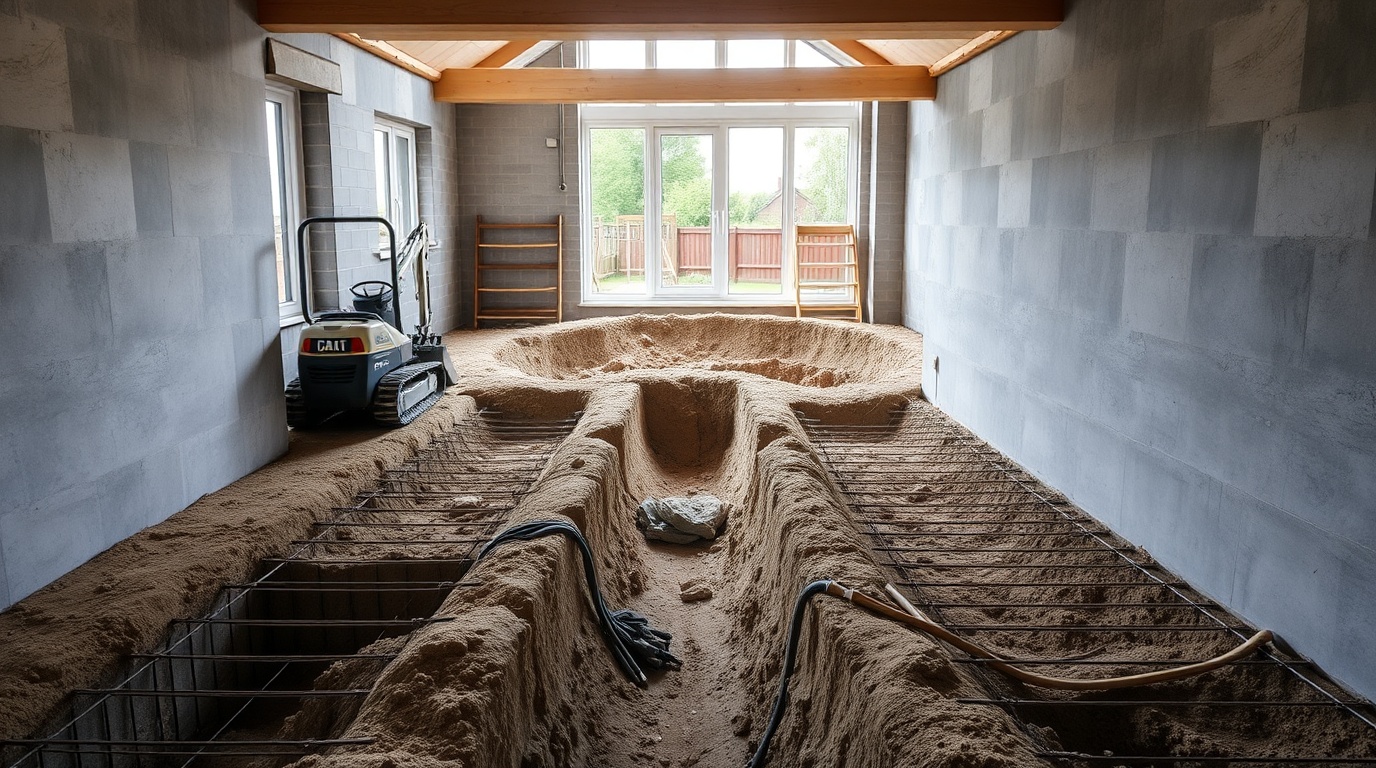
A groundworks quote for an extension normally bundles several stages. It starts with site setup and excavation — marking out, removing topsoil and digging the foundation trenches and any reduced-level dig for the slab. Next comes foundation concrete, either a deep trench-fill pour or a strip footing with masonry built off it. The substructure brickwork or blockwork is then built up to damp-proof course, and the ground-floor construction follows, usually a concrete slab on hardcore and insulation, or a beam-and-block floor.
The price also carries drainage connections within the footprint, disposal of excavated spoil (muck away), and the labour and plant hire to do it all. What it often does not include is diverting an existing drain, sewer or service that runs under the new footprint, underpinning an adjacent foundation, or any structural steel — those are usually priced separately. Reading the quote line by line is the only fair way to compare two groundworkers, because one may include the slab and drains while another stops at oversite level.
What pushes the price up
Ground conditions are the single biggest variable. Firm gravel needs only a standard 1m foundation; shrinkable clay, especially near trees, can demand 2m or deeper, doubling the dig and concrete volume. Trees within influencing distance trigger NHBC and Building Control rules on foundation depth that often catch homeowners out. Made-up ground, old foundations or a high water table may force a piled or raft design costing several times a standard footing.
Access matters too: a rear extension reached only through a narrow side return means barrowing spoil out and concrete in by hand, which is slower and dearer than a site a mini-digger can reach directly. Drainage adds cost where an existing run crosses the footprint and must be diverted or built over with Building Control approval, and the Party Wall etc. Act 1996 may apply where you dig within three or six metres of a neighbour's structure, adding survey and award costs. Spoil disposal also feeds in, as muck away is charged by the load and rises sharply on deep or large digs.
The detail that most often turns a reasonable groundworks quote into a painful one is foundation depth, because it drives three costs at once. A deeper trench means more excavation, a larger volume of concrete to fill it (on a trench-fill foundation), and more spoil to cart away, each charged separately. A foundation that goes from 1m to 2m does not add 50% to the bill — it can roughly double the dig, the concrete and the muck away together, which is why the same extension footprint can cost very different amounts on different plots.
This compounding is also why the standard advice is to establish the likely depth before the work is priced. A trial hole, dug with a small machine for a modest fee, lets the groundworker and Building Control see the soil profile and judge how deep the foundation must go. On clay near trees the answer is often sobering, but knowing it up front lets you budget honestly rather than discovering it once the digger is in and the trench is open. The alternative — pricing on an optimistic 1m assumption and then finding the foundation needs to be 2.2m to satisfy the inspector — is the single most common reason an extension groundworks bill overruns. Treating depth as the key number, and getting it confirmed early, is the most useful thing a homeowner can do to keep this stage under control.
Where groundworks sit in the wider extension budget
Groundworks typically account for roughly 10–15% of the total cost of an extension, though this varies with site difficulty. On a straightforward single-storey extension costing perhaps £40,000–£60,000 all-in, groundworks of £6,000–£9,000 are a reasonable share. On a difficult site where foundations have to be piled, that share can climb well above 15% even though the visible result above ground looks identical. This is why two extensions of the same size can have very different groundworks bills — the cost is buried.
It is worth treating the groundworks stage as the part of the project most likely to overrun, and budgeting a contingency of around 10–15% on top of the quoted figure specifically for below-ground surprises. A foundation that has to go a metre deeper than expected, an unrecorded drain, or contaminated spoil that costs more to dispose of are all common and rarely visible until the digger is in. Building Control will inspect the open foundation trench before any concrete is poured, and may require a deeper or reinforced footing on the spot, so the final depth is not fully within either your or the groundworker's control. Getting a soil report and a clear, itemised quote up front is the best protection against the figure drifting.
Frequently asked questions
Are groundworks the most expensive part of an extension?
Not usually — they are typically 10–15% of the total, behind the superstructure, roof and internal fit-out. But they are the least predictable part, because the cost depends on what is found below ground, which is why contingency matters most at this stage.
How deep do extension foundations need to be?
It depends on the soil. A standard minimum is around 1m on firm ground, but shrinkable clay or nearby trees can require 2m or more. Building Control inspects the open trench and confirms the required depth before concrete is poured.
Do I need Building Control for extension groundworks?
Yes. The foundations and floor must comply with Building Regulations Part A (structure) and be inspected by Building Control or an approved inspector at key stages, including the open foundation trench before concreting.
Sources & further reading
- Checkatrade — groundworks cost guide
- Planning Portal — Building Regulations and extensions
- NHBC — foundation depths and trees guidance
Figures on this page are typical UK ranges drawn from published sources and depend on your specific site. They are guidance, not a quotation.