The short answer
Groundworks for a new build house in the UK typically cost between £20,000 and £50,000, with many detached self-builds landing around £25,000–£40,000. A large house, a difficult sloping or clay plot, or one needing piled foundations can exceed £50,000–£80,000+. The figure covers site clearance, setting out, excavation, foundations, the ground-floor slab or beam-and-block floor, below-ground drainage and the connections to services. Foundations must satisfy Building Regulations Part A, and most new homes are built to NHBC or equivalent warranty standards, which set minimum foundation and drainage details inspected by Building Control.
On a self-build or developer plot, groundworks are the first major spend and set the tone for the whole project. The figure ranges widely because ground conditions and foundation type vary so much from plot to plot. The sections below give indicative ranges, explain the stages and set out what most affects the cost.
At a glance
- Typical detached house~£20,000–£50,000
- Difficult / piled plot£50,000–£80,000+
- Share of total buildAround 10–15%
- Foundation standardPart A / NHBC
- Biggest variableGround conditions
Typical new build groundworks costs
New build groundworks cover the substructure — everything below the damp-proof course — plus drainage and the ground floor. On a level plot with firm ground, a standard trench-fill foundation and a beam-and-block floor keep the cost contained. On a sloping site, made-up ground or shrinkable clay, foundations get deeper, retaining or piling may be needed, and the figure climbs. The ranges below are indicative for a single dwelling and assume conventional foundations rather than a fully engineered solution.
| House type / plot | Indicative groundworks cost | Notes |
|---|---|---|
| Small house, good ground | £18,000–£28,000 | Trench-fill, level plot |
| Average detached, level | £25,000–£40,000 | Standard foundations + slab |
| Large detached | £35,000–£55,000 | Bigger footprint, more drainage |
| Sloping plot | £40,000–£65,000 | Retaining, level platform |
| Piled foundations | £50,000–£80,000+ | Engineered, poor ground |
Indicative figures for guidance only. Plot conditions cause wide variation between sites.
What the groundworks package covers
A new build groundworks package usually runs from site clearance and setting out through to a level oversite ready for the superstructure. It includes excavation of foundations and any reduced-level dig, foundation concrete (trench-fill, strip or a raft), and the substructure masonry up to damp-proof course. It covers the ground-floor construction — typically beam-and-block or a ground-bearing slab on hardcore and insulation — and the below-ground drainage, including foul and surface water runs, inspection chambers and connections.
Larger packages may also include the incoming service ducts, a soakaway or attenuation crate for surface water under SUDS requirements, and external works such as the base for a driveway. What is usually priced separately, or excluded, is the mains water, electric and gas connections themselves (charged by the utility), any retaining walls beyond the immediate substructure, and contaminated land remediation. Because scope varies so much between groundworkers, the only reliable comparison is a line-by-line breakdown rather than a single headline number.
What drives the cost up or down
Ground conditions dominate. Firm, free-draining ground allows shallow, cheap foundations; shrinkable clay near trees, peat, made-up ground or a high water table can force piling or a raft, which can add tens of thousands. Slope is the next biggest factor — a sloping plot needs cut-and-fill to create a level platform, often with retaining structures, and generates far more spoil to dispose of. Plot size and house footprint set the sheer volume of dig, concrete and drainage.
Spoil disposal (muck away) is a significant line on any new build, charged by the lorry load and rising fast where the dig is deep or the ground contaminated. Drainage complexity matters where the plot is far from the connection point or the ground will not take a soakaway, requiring attenuation. Access affects plant choice and speed, and region shifts labour rates, with the South East higher than much of the North. Finally, the warranty provider — NHBC, LABC or similar — sets minimum standards that the foundations and drainage must meet, and their inspections can require upgrades on site.
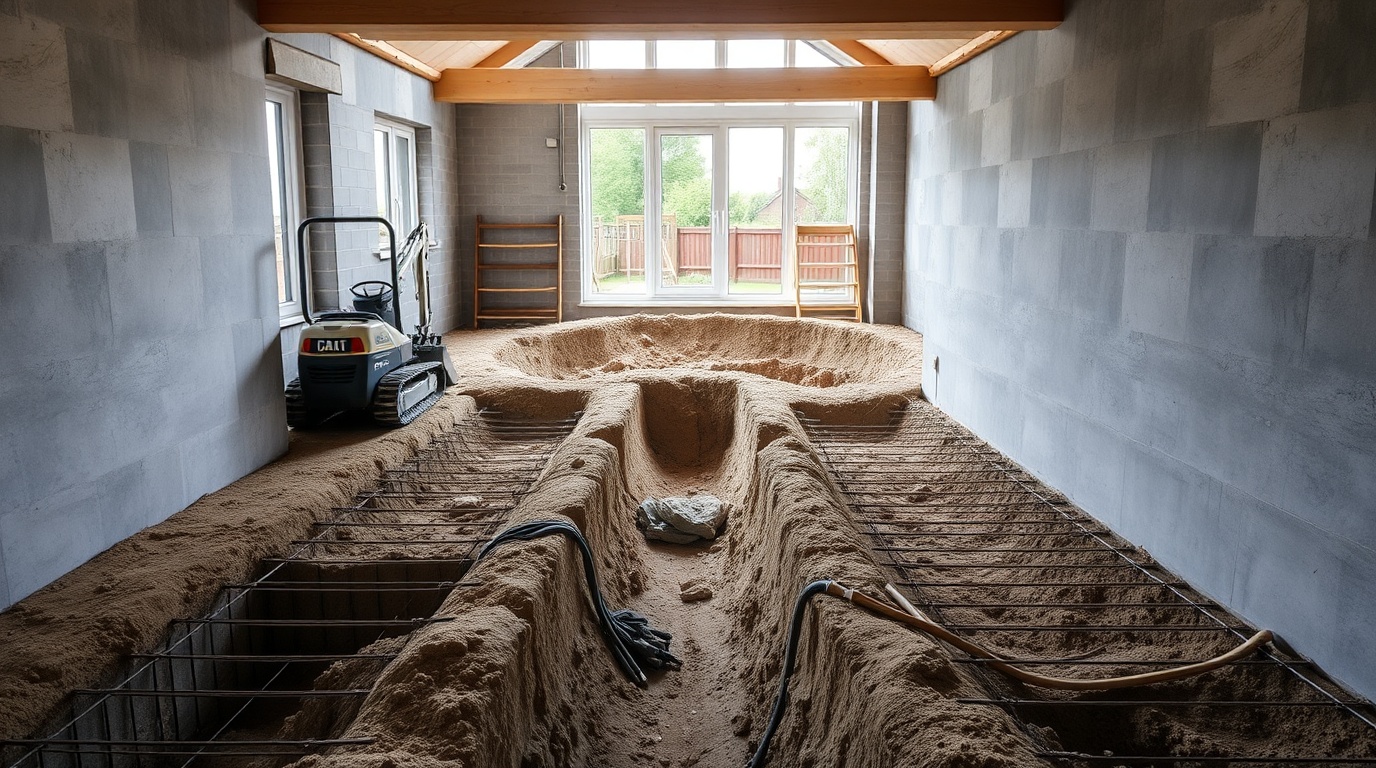
A sloping site is one of the biggest cost multipliers in new build groundworks, and it is easy to underestimate from a flat photograph. To build on a slope you first have to create a level platform, which means cut-and-fill: cutting into the high side and either removing that soil or using it to build up the low side. Cutting generates large volumes of spoil to dispose of, and filling has to be done in compacted layers with engineered fill, because loose tipped soil will settle and crack whatever is built on it. Both directions cost money.
A slope also frequently demands retaining structures to hold back the cut face or support the fill, and these are substantial reinforced-concrete or block elements in their own right, designed by the structural engineer. Drainage is more complex on a slope, with surface water management and sometimes land drains needed to stop water tracking down through the platform. And access for plant and concrete deliveries is harder, slowing the work. A skilled groundworker will try to balance the cut-and-fill so that soil removed from the high side fills the low side, minimising both import and disposal — getting this balance right is one of the largest savings available on a sloping plot, and one of the clearest signs of a well-planned job. Where the slope is steep, the groundworks can become the dominant cost of the whole build, which is why a level plot is so much cheaper to develop than a sloping one of the same size.
Budgeting and the order of works
Because groundworks are typically 10–15% of the total build cost but the least predictable element, self-builders are wise to hold a contingency specifically for below-ground risk. A foundation that has to go deeper, a soakaway that fails its percolation test and forces an attenuation system, or unexpected obstructions all surface during this stage and rarely after. Sequencing also matters: services, drainage levels and the slab all have to be coordinated, and a mistake set into concrete is expensive to correct later.
It pays to have a structural engineer's foundation design and a drainage layout agreed with Building Control before the groundworker starts, rather than designing on the hoof. The engineer specifies foundation depth and reinforcement based on the soil report; Building Control inspects the open trenches, the drainage before backfill, and the oversite. Getting these inspections booked and passed keeps the warranty valid and avoids the costly scenario of having to open up completed work. A clear, staged programme — clearance, dig, foundations, drainage, floor, oversite — with a fixed-price quote against a proper design is the most reliable way to keep the groundworks figure under control on a new build.
Frequently asked questions
What share of a new build cost is groundworks?
Typically around 10–15% of the total build, though it can be higher on a difficult or sloping plot needing piling or retaining structures. On a level plot with firm ground it can be at the lower end of that range.
Do new build foundations need NHBC approval?
If the home is covered by an NHBC warranty, the foundations and drainage must meet NHBC standards and pass their inspections, alongside Building Control sign-off under Part A. Other warranty providers such as LABC have equivalent requirements.
Why can two identical houses have very different groundworks costs?
Because the cost is driven by what is below ground. One plot may need a shallow trench-fill foundation; an identical house on clay or made-up ground may need piling or a raft costing several times as much, even though the house above looks the same.
Sources & further reading
- Checkatrade — groundworks cost guide
- NHBC Standards — foundations
- Planning Portal — Building Regulations
Figures on this page are typical UK ranges drawn from published sources and depend on your specific site. They are guidance, not a quotation.