The short answer
Groundworks for a garden room base in the UK typically cost between £1,500 and £5,000, depending on the base type and size. A concrete slab for a standard room often runs £2,000–£4,000; a ground-screw foundation is frequently £1,500–£3,500 and far quicker; and a steel or timber-framed raised platform sits in a similar range. The figure covers excavation or screw installation, the base itself, and getting it level. Garden rooms usually fall under permitted development if under 2.5m high near a boundary and used incidentally to the house, but the base still needs to be sound — and Building Regulations apply if the room exceeds size or use limits.
The base is the part of a garden room people tend to underestimate, yet it determines how level, dry and durable the building will be. There are several base types at different costs. The sections below compare them, explain what the groundworks include, and cover the planning and regulation points worth knowing.
At a glance
- Concrete slab~£2,000–£4,000
- Ground screws~£1,500–£3,500
- Typical overall range~£1,500–£5,000
- Permitted developmentUsually, within limits
- Key requirementLevel, stable, well-drained
Base options and their costs
Garden room groundworks vary more by base type than by anything else. A concrete slab is the traditional, solid choice; ground screws are a faster, lower-disturbance alternative gaining popularity; and various raised platforms suit sloping or wet ground. Each has a different cost, installation time and impact on the garden. The ranges below are indicative for a standard room of around 3m × 4m and assume reasonable access and ground.
| Base type | Indicative cost | Best for |
|---|---|---|
| Concrete slab | £2,000–£4,000 | Solid, level, firm ground |
| Ground screws | £1,500–£3,500 | Speed, minimal dig, slopes |
| Steel frame + screws | £2,500–£4,500 | Sloping or soft ground |
| Paving / pad foundations | £1,200–£2,800 | Lighter buildings |
| Raised timber deck base | £1,500–£3,500 | Uneven ground |
Indicative figures for guidance only. Costs vary with size, ground conditions and access.
What the groundworks include
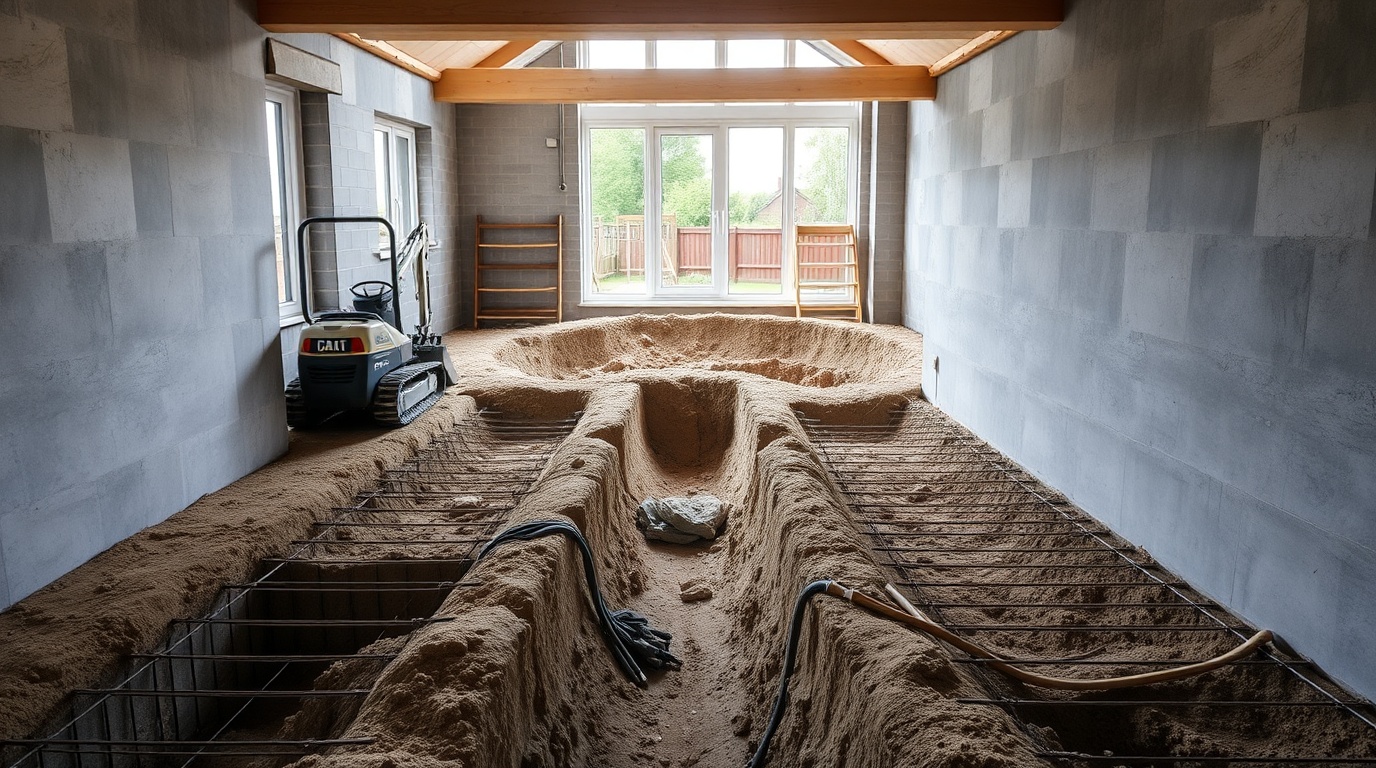
For a concrete slab, the groundworks cover excavation and removal of topsoil, a compacted sub-base of crushed stone, edge shuttering, a damp-proof membrane, often a layer of insulation, and the concrete pour, all set dead level. For a ground-screw base, the work is installing the screws to depth with a machine, levelling their heads and fixing a steel or timber sub-frame on top — with almost no dig and no spoil to remove, which is part of the appeal. Other bases sit between these in scope.
The groundworks should also handle drainage and levels so water runs away from the building rather than pooling under it. What is usually excluded is the building itself, any electrical supply trench and cable from the house (a separate, notifiable electrical job under Part P), and significant landscaping to reach the site. As with any groundworks, the fair way to compare quotes is to check exactly where the base preparation ends — whether it includes insulation and a membrane, for instance — rather than comparing headline figures that may cover different scopes.
Ground screws versus a slab in practice
For many garden rooms the real decision is between a concrete slab and a ground-screw foundation, and the two behave very differently on site. A concrete slab means excavation, removing topsoil as spoil, laying and compacting a sub-base, shuttering, a membrane, often insulation, and a concrete pour that then needs days to cure before building can start. It produces a solid, heavy, permanent base ideal for firm, level ground, but on a slope or soft soil the dig and levelling can balloon the cost, and the spoil disposal alone can be a significant line.
Ground screws are large steel screws wound into the ground by machine to a depth that finds firm bearing, with a steel or timber sub-frame fixed across their levelled heads. They install in a day with almost no excavation and no spoil to remove, can be loaded immediately with no curing wait, and adjust easily to a slope by simply screwing each to a different depth. They also leave the ground largely intact, which suits gardens with tree roots nearby or where minimal disturbance matters. The trade-off is that they suit lighter timber-framed garden rooms rather than heavy masonry buildings, and a poorly chosen screw spec on the wrong ground can perform worse than a slab. On firm, level ground the two can cost much the same; the screw advantage grows on slopes, soft ground and restricted-access sites where a slab would need extensive, expensive groundworks to achieve the same level, stable result.
What changes the price, and the rules
Cost is driven by base type, size and ground conditions. A slab on firm, level ground is straightforward; a slab on a slope needs cut-and-fill, retaining and far more spoil disposal, which can make ground screws the lower-cost route. Access matters because a garden room site is often reached only through the house or a narrow gate, meaning materials and spoil are barrowed by hand, which is slow and dear. Trees nearby can affect both the foundation choice and, occasionally, planning if they are protected.
On the rules, most garden rooms are permitted development, meaning no planning application, provided the building is single-storey, used incidentally to the house (not as a separate dwelling), and within height limits — broadly 2.5m where it is within two metres of a boundary, or up to 3–4m further in. It must not cover more than half the garden and there are extra restrictions on listed buildings and conservation areas, so checking with the local planning authority is sensible. Building Regulations generally do not apply to a small detached outbuilding under 15m² with no sleeping accommodation, but a larger room, or one used as habitable space or close to a boundary in terms of fire spread, can bring them into play. The base itself is not regulated the way a house foundation is, but it still needs to be level, stable and well-drained — getting that right at the groundworks stage is what keeps the finished room dry and true for years.
Frequently asked questions
Are ground screws cheaper than a concrete slab for a garden room?
Often, especially on sloping or soft ground where a slab would need extensive excavation and levelling. Ground screws install in a day with little spoil, whereas a slab involves digging, sub-base, membrane and a concrete pour. On firm, level ground the costs can be similar.
Do I need planning permission for a garden room base?
Usually not — most garden rooms fall under permitted development if single-storey, used incidentally to the house and within height limits (broadly 2.5m near a boundary). Listed buildings, conservation areas and larger or habitable rooms may need an application, so check with your local authority.
Does a garden room base need Building Regulations approval?
A small detached outbuilding under 15m² with no sleeping accommodation is generally exempt. Larger rooms, those used as habitable space, or those close to a boundary for fire-spread reasons can require Building Control sign-off.
Sources & further reading
- Planning Portal — outbuildings
- Checkatrade — garden room cost guide
- Planning Portal — Building Regulations exemptions
Figures on this page are typical UK ranges drawn from published sources and depend on your specific site. They are guidance, not a quotation.