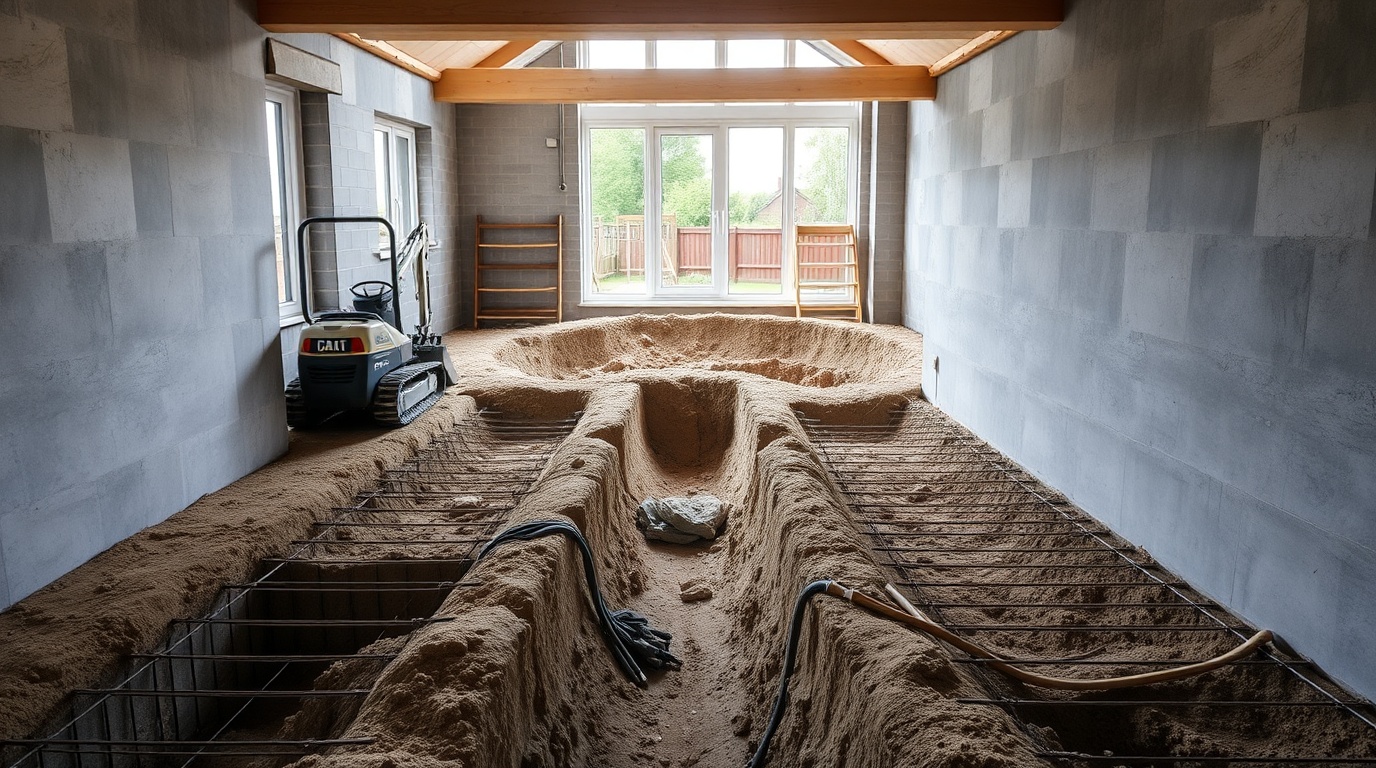
The short answer
Groundworks are sometimes included in a build quote and sometimes priced separately — it depends entirely on how the quote is structured. A main contractor's all-in price usually includes them, but the foundations are often shown as a provisional sum rather than a fixed figure, because their cost depends on ground conditions that are unknown until the trench is dug. A quote from a builder who excludes the substructure, or who lists groundworks as 'by others', leaves you to arrange and pay for them separately. Always check whether foundations, drainage and the floor slab are firm prices, provisional sums, or excluded, because this is where build budgets most often slip.
Whether a quote covers groundworks is one of the most important things to clarify before signing, yet it is frequently glossed over. The wording matters: 'included' can mean a firm price or a placeholder. The sections below explain how groundworks appear in quotes, what a provisional sum really is, and exactly what to check.
At a glance
- Often included?Yes, in all-in quotes
- Foundations usually shown asProvisional sum
- Commonly excludedDrainage diversions, piling
- Why it variesUnknown ground conditions
- What to checkFirm vs provisional vs excluded
How groundworks appear in a quote
There is no single convention, which is why this causes confusion. A main contractor offering an all-in price for an extension or house will normally include the groundworks somewhere in the figure, but how they are priced varies. They may be a firm fixed price, a provisional sum, or split — a firm price for the dig and floor, with foundations provisional. A smaller builder may exclude the substructure entirely and expect a specialist groundworker to be engaged separately. The table below sets out the common arrangements.
| How it appears | What it means | Your risk |
|---|---|---|
| Firm fixed price | Set figure for the whole substructure | Low — contractor carries it |
| Provisional sum | An estimate, adjusted to actual | Medium — final cost may rise |
| Prime cost / PC sum | Allowance for a specific item | Medium — depends on selection |
| 'Groundworks by others' | Not included; you arrange it | High — separate cost entirely |
| Excluded / not stated | Ambiguous; clarify before signing | High — assumption risk |
Common ways groundworks appear in UK build quotes. Always confirm in writing.
Why foundations are often a provisional sum
The reason foundations are so often shown as a provisional sum rather than a fixed price is genuine, not evasive. Until the foundation trench is dug and Building Control inspects it, no one knows for certain how deep it must go. Shrinkable clay, made-up ground, a high water table or roots near trees can all force a deeper or reinforced foundation than assumed, and the contractor cannot fairly carry that open-ended risk in a fixed price without padding it heavily. A provisional sum lets them allow a reasonable figure that is then adjusted up or down against the actual depth and concrete used.
The practical consequence is that an extension quote with an attractive headline price may carry a provisional foundation sum that increases once work starts. This is normal and fair, but only if you understand it going in. The protection is a soil survey or trial hole before the quote, which lets the figure be based on real ground rather than an optimistic assumption, and a clear method for how the provisional sum will be measured and adjusted. Without that, the foundation line is effectively a placeholder, and the final bill can differ noticeably from the quote — through no bad faith, simply because the ground turned out different from the guess.
Provisional sums versus PC sums in practice
Two terms get used loosely in quotes and they are not the same, so it helps to know which you are looking at. A provisional sum is an allowance for work whose scope or cost is not yet fully known — foundations are the classic example, because the depth is uncertain until the trench is open. It is measured against what is actually done and adjusted, so it can move up or down. A prime cost sum (PC sum) is an allowance for a specific item or material that will be chosen later — a particular drainage fitting, say, or a specified type of damp-proof membrane — where the labour to install it is known but the supply price is not yet fixed. The distinction matters because a provisional sum carries scope risk, while a PC sum mostly carries selection risk.
In a groundworks context, you will usually see the foundations as a provisional sum and the floor build-up or specific drainage components as PC sums, with the excavation and muck away sometimes firm and sometimes provisional depending on how confident the contractor is about the ground. The reason this is worth understanding is that it tells you which lines can move and why. A provisional foundation sum that doubles because the trench had to go to 2m is a scope change driven by the ground; a PC sum that rises because you chose a more expensive fitting is a selection you controlled. When the final account arrives, knowing which allowances were provisional and which were PC sums lets you see whether an increase was genuinely unavoidable or a choice — and that is exactly the clarity that stops a build budget feeling like it ran away on its own. Asking the contractor to mark each substructure line as firm, provisional or PC before you sign turns a vague figure into one you can actually hold them to.
What to check before you sign
Before agreeing any build quote, work through the substructure line by line. Confirm whether it includes excavation, foundations, below-ground drainage and the ground floor, and whether each is firm or provisional. Check what is excluded: common omissions are diverting an existing drain or sewer under the footprint, underpinning a neighbouring foundation, piling, contaminated spoil disposal, and service connections — any of which can add thousands if they apply to your site. Ask how variations in foundation depth will be priced if the trench has to go deeper than the provisional sum assumes.
It also helps to understand who carries the Building Control relationship and inspections, and whether the warranty or guarantee covers the substructure. On a new home, the foundations and drainage must meet NHBC or equivalent standards as well as Building Regulations Part A, so confirm the contractor is building to the required standard and booking the inspections. The single biggest cause of a build budget slipping is a vague substructure line that turns out to be a provisional sum, an exclusion, or a 'by others' that the homeowner did not register. Getting the scope, the pricing basis and the variation method in writing before work starts is the most effective protection — far more useful than the headline quote figure, which on its own tells you little about where the groundworks risk actually lies.
Frequently asked questions
What is a provisional sum for groundworks?
An allowance in the quote for work that cannot be fixed-priced yet, usually because the foundation depth depends on ground conditions not known until the trench is dug. The final cost is measured against actual work done and adjusted up or down from the allowance.
Can a builder add to the price if foundations go deeper?
Yes, where foundations are a provisional sum or the contract allows for variations. If Building Control requires a deeper or reinforced foundation after inspecting the open trench, the extra concrete, dig and spoil disposal are typically charged on top of the original allowance.
What is commonly excluded from a build quote's groundworks?
Frequent exclusions are diverting drains or sewers under the footprint, underpinning neighbouring foundations, piling, contaminated spoil disposal and utility service connections. Check the quote's exclusions carefully, as any of these can add significant cost if they apply.
Sources & further reading
- RICS — provisional sums and building contracts
- Planning Portal — Building Regulations
- Checkatrade — groundworks cost guide
Figures on this page are typical UK ranges drawn from published sources and depend on your specific site. They are guidance, not a quotation.